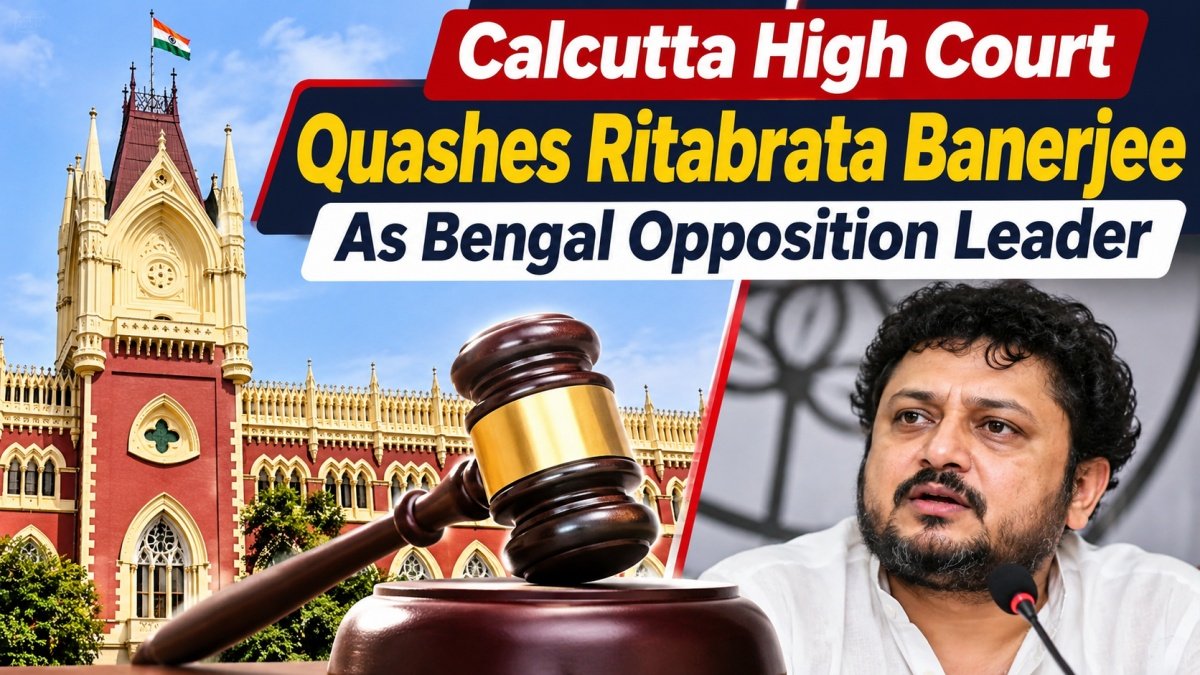
The Calcutta High Court has quashed the West Bengal Assembly Speaker’s order appointing Ritabrata Banerjee as Leader of the Opposition and Akhurujaman as Chief Whip.
Key Points
- Court Ruling: The High Court declared the Speaker’s appointment order as incorrect.
- Reconsideration Order: The Speaker has 10 days to review the appointments as per legal provisions.
- Petition Source: The decision followed a petition filed by Shobhendu Chattopadhyay.
- Internal Rebellion: 58 TMC MLAs broke away to support the rebel faction’s leadership.
High Court Sets Aside Speaker’s Order
KOLKATA: The Calcutta High Court on Friday quashed the order issued by the West Bengal Assembly Speaker, which had appointed Ritabrata Banerjee as the Leader of the Opposition and Akhurujaman as the Chief Whip on June 3. The court observed that the Speaker’s order was incorrect and failed to align with proper legal procedures.
The court has directed the Assembly Speaker to reconsider both appointments within 10 days of receiving a copy of the judgment. This ruling follows a petition filed by Shobhendu Chattopadhyay, a prominent leader within the Mamata Banerjee group, seeking to challenge the rebel faction’s hold on the opposition post.
Political Fallout and Next Steps
The court’s decision creates a significant legal and political vacuum for both factions. Following the ruling, the Assembly Speaker is required to take a fresh decision after evaluating the arguments presented by both sides and the relevant legal provisions. The status of Ritabrata Banerjee’s post is no longer intact based on the previous order.
Political analysts suggest three primary outcomes. Shobhendu Chattopadhyay may re-assert his claim based on the official stance of the Trinamool Congress (TMC). Alternatively, Ritabrata Banerjee might demand a formal re-appointment, though his current position remains legally void. The Speaker will ultimately need to balance the competing claims of the two factions.
Origins of the TMC Rebellion
The internal conflict within the Trinamool Congress intensified following the 2026 Assembly elections, where the party won 80 seats. Initially, Mamata Banerjee intended to appoint Shobhendu Chattopadhyay as the Leader of the Opposition. However, a meeting of MLAs on May 6 led to a consensus on his name, but a subsequent proposal sent to the Speaker on May 19 sparked allegations of forged signatures by Ritabrata Banerjee.
The rebellion escalated in June when 20 out of the party’s 27 Lok Sabha MPs broke away to form an alliance with the NCPI, supporting the NDA. In the Assembly, 58 MLAs supported Ritabrata Banerjee, leading to the formation of a parallel organization with Arup Roy as President. The Election Commission eventually granted separate identities to both groups, naming the Mamata group ‘Mamata All India Trinamool Congress’ and the rebel group ‘Democratic Trinamool Congress’.
Latest Developments
Following the court’s decision, various news outlets have reported on the immediate impact. According to The News Mill and Madhyamam, the court’s action is seen as a significant setback for the rebel camp. Meanwhile, reports from ANI indicate that Ritabrata Banerjee has downplayed the court’s order, while Kalyan Banerjee has accused his rival of fraud regarding public funds.
According to India.com and Oneindia, the ruling is being viewed as a relief for Mamata Banerjee’s faction, as it effectively halts the rebel group’s official recognition as the primary opposition in the state assembly.