






























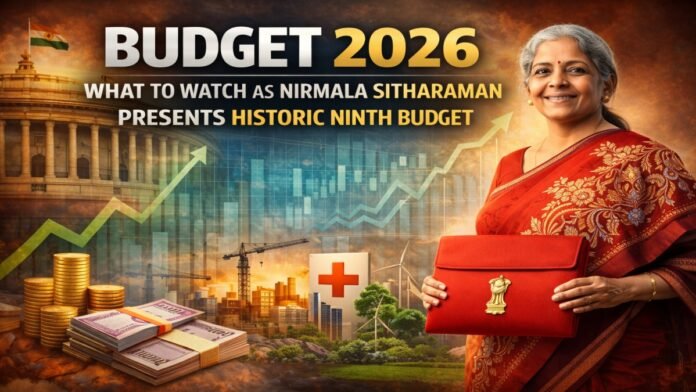
Key Points:
- First-ever Union Budget to be presented on a Sunday
- Ninth consecutive budget by Finance Minister Nirmala Sitharaman
- High expectations amid global uncertainty and Developed India by 2047 goal
- Focus likely on tax relief, fiscal deficit, defence, infrastructure, and rural economy
- Markets to track policy signals closely
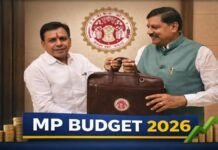
Union Finance Minister Nirmala Sitharaman is set to create history on February 1, 2026, by presenting her ninth consecutive Union Budget. This will also mark the first time in Indian history that the Union Budget is presented on a Sunday. Against the backdrop of global economic uncertainty and India’s long-term vision of becoming a Developed India by 2047, this budget is expected to carry wide-ranging implications for households, businesses, and investors.
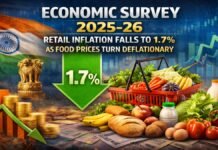
Ahead of the budget, the Finance Minister tabled the Economic Survey on Thursday, January 29, outlining the economy’s performance in the previous financial year and growth projections for the year ahead. With growth holding steady and inflation easing, expectations from Budget 2026 are running high.
1. Income Tax Slabs and Middle-Class Relief
Income tax reforms remain the most closely watched aspect of any budget, especially for the salaried middle class. Following encouraging macroeconomic indicators in the Economic Survey, the government is expected to announce measures to make the new tax regime more attractive.
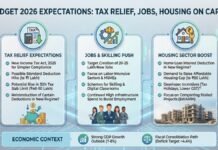
Market expectations suggest that the standard deduction could be increased from the current ₹50,000 to ₹1,00,000. There is also speculation that the income threshold for the highest 30% tax slab, currently applicable beyond ₹24 lakh, could be raised to ₹40 lakh or even ₹50 lakh, offering significant relief to higher-income earners.
2. Fiscal Deficit Target and GDP Growth
Fiscal discipline will be another key area of focus. The Economic Survey 2026 projects India’s GDP growth at 6.8% to 7.2% for the next financial year, indicating sustained economic momentum.
Investors and rating agencies will closely track whether the government manages to lower the fiscal deficit target to around 4.3% by FY27. Achieving this target is critical for maintaining market confidence, keeping borrowing costs under control, and managing inflationary pressures.
3. Make in India Push and Defence Allocation
With India’s increasing focus on self-reliance in defence manufacturing, Budget 2026 is expected to announce a strong push for the sector. A nearly 15% increase in defence capital expenditure is widely anticipated.
Reports also suggest that the government may roll out additional Production Linked Incentive schemes for drone startups, the semiconductor mission, and domestic manufacturing of military equipment. Such measures could act as major triggers for defence and manufacturing sector stocks.
4. Infrastructure Spending and Green Highways
Infrastructure development, particularly road and highway expansion, is expected to receive a major boost. Significant allocations are likely for the Ministry of Road Transport and Highways.
Key announcements to watch include a proposed ₹5,000 crore special fund for green-electric national highways and the adoption of advanced technologies such as satellite-based toll collection. The government also plans to raise around ₹35,000 crore through road asset monetisation, with proceeds expected to be reinvested in green and sustainable infrastructure projects.
5. Rural Economy, MSP, and Farm Support
The rural economy is expected to be another major focus area in Budget 2026. Announcements related to Minimum Support Price hikes, crop insurance schemes, and potential enhancements to the PM-Kisan income support program will be closely monitored.
To boost rural consumption, the government may increase spending on MNREGA and agricultural infrastructure. Such measures have a direct impact on rural demand and could benefit sectors like FMCG, tractors, and entry-level automobiles.
What to Watch Going Forward
Budget 2026 is expected to strike a balance between growth support and fiscal prudence. With inflation under control and growth projections stable, policy signals on taxation, capital expenditure, and rural spending will play a decisive role in shaping market sentiment and economic momentum in the coming year.