


























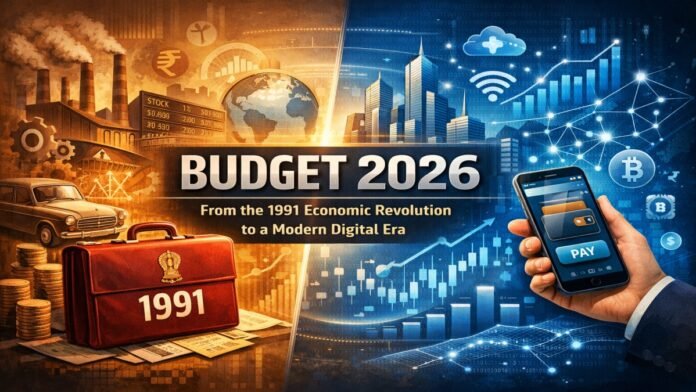
Key Highlights
- Historic Milestone: Nirmala Sitharaman will present her ninth consecutive Union Budget on February 1, 2026, focusing on infrastructure and digital growth.
- 1991 Legacy: A look back at the Balance of Payments crisis when India had less than three weeks of foreign exchange reserves.
- The “LPG” Era: How Liberalization, Privatization, and Globalization dismantled the restrictive “License Raj.”
- 2026 Projections: Early reports suggest a record ₹2.80 lakh crore allocation for Indian Railways and significant investments in Artificial Intelligence.
Before the landmark shifts of 1991, India was trapped in a crippling economic stalemate. The country faced a severe Balance of Payments (BoP) crisis, exacerbated by the Gulf War and rising oil prices. Foreign exchange reserves had depleted to approximately $1.2 billion, barely enough to cover two weeks of essential imports.
The situation grew so desperate that the government was forced to airlift 47 tonnes of gold to the Bank of England and the Union Bank of Switzerland to secure emergency loans. Domestically, inflation was in double digits, and the credit rating of the country had been downgraded to “junk” status, making international borrowing nearly impossible.
The Architect of Change: Rao and Singh
In June 1991, the government led by Prime Minister P.V. Narasimha Rao and Finance Minister Dr. Manmohan Singh took a radical departure from the socialist-leaning policies of the past. Dr. Singh’s budget speech is still cited as a turning point in Indian history, famously quoting Victor Hugo: “No power on earth can stop an idea whose time has come.”
The 1991 budget was not merely a financial statement; it was a blueprint for a new India. By devaluing the rupee and initiating structural adjustments, the leadership signalled to the world that India was open for business.
Dismantling the License Raj
The most revolutionary aspect of the 1991 reforms was the abolition of the “License Raj,” a complex system of licenses and regulations that stifled private enterprise. Previously, businesses required government approval for everything from production capacity to expansion, a process often marred by bureaucracy and corruption.
The new industrial policy ended the state monopoly in many sectors, allowing the private sector to compete and innovate. Furthermore, customs duties, which were as high as 220 per cent, were slashed to 150 per cent in the first phase, eventually falling further to integrate India into the global supply chain.
Impact: From Survival to Global Power
The results of the 1991 reforms were almost immediate. Foreign Direct Investment (FDI) began to flow into the country, and the service sector, particularly IT, saw exponential growth. Experts suggest that without this “Big Bang” reform, India might have faced a prolonged period of economic stagnation similar to other developing nations that failed to liberalise.
Looking Ahead: Expectations for Budget 2026
Fast forward to 2026, the context of the Union Budget has shifted from crisis management to maintaining the momentum of a “Viksit Bharat” (Developed India). Finance Minister Nirmala Sitharaman’s upcoming presentation is expected to be a milestone in modern governance.
Latest Updates and Trends:
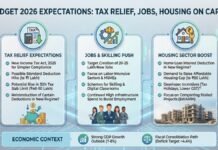
- Railway Revolution: The auto and transport sectors are bracing for a massive infrastructure boost, with an expected record allocation of ₹2.80 lakh crore for the railways. This includes the widespread rollout of sleeper Vande Bharat trains and the integration of AI for traffic management.
- The Digital Push: Google Trends data indicates that public interest in the “Budget” has surpassed “Income Tax” over the last three years, reflecting a broader public interest in macroeconomic policy rather than just personal tax slabs.
- Middle-Class Focus: While income tax remains a hot topic, experts emphasise that non-income taxpayers should also watch the 2026 budget closely, as indirect tax changes and welfare schemes for the auto and housing sectors will directly impact their cost of living.
As India prepares for February 1, the shadows of 1991 serve as a reminder of how bold political will can redefine a nation’s trajectory. The 2026 budget is poised to be the next chapter in that ongoing story of self-reliance and global leadership.