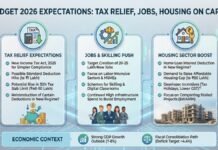




























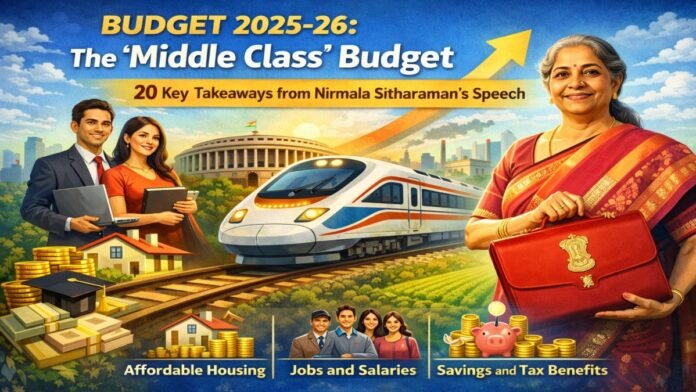
NEW DELHI – In a move that signalled a major pivot toward household relief and structural economic overhauls, Finance Minister Nirmala Sitharaman presented the Union Budget for 2025-26 today. Against a backdrop of global geopolitical headwinds, the Minister laid out a vision for a “Viksit Bharat” (Developed India), positioning the middle class, agriculture, and MSMEs as the primary engines of the nation’s growth.
The headline-grabbing announcement was undoubtedly the sweeping reform of the personal income tax structure, but the budget also delved deep into rural resilience, energy transition, and a radical simplification of the regulatory landscape.
Here are the top 20 key points from the Budget 2025-26 speech:
1. Massive Income Tax Relief: No Tax up to ₹12.75 Lakh
In perhaps the most significant middle-class outreach in recent years, the Finance Minister announced that there will be no income tax payable for those with an income up to ₹12 lakh under the New Tax Regime. When combined with the standard deduction of ₹75,000, salaried taxpayers with an income of up to ₹12.75 lakh will effectively pay zero tax. This move is designed to put more disposable income into the hands of households to spur consumption.
2. Revamped Tax Slabs for the New Regime
To benefit taxpayers across all brackets, the tax slabs have been widened. The new structure is:
- ₹0-4 Lakh: Nil
- ₹4-8 Lakh: 5%
- ₹8-12 Lakh: 10%
- ₹12-16 Lakh: 15%
- ₹16-20 Lakh: 20%
- ₹20-24 Lakh: 25%
- Above ₹24 Lakh: 30%
3. ‘Agriculture as the First Engine’: PM Dhan-Dhaanya Krishi Yojana
Inspired by the success of the Aspirational Districts Programme, the government will launch the Prime Minister Dhan-Dhaanya Krishi Yojana. This will cover 100 districts with low productivity, focusing on crop diversification, sustainable practices, and improving credit availability. It is expected to benefit 1.7 crore farmers.
4. MSME Reclassification: Boosting Growth Limits
To help MSMEs achieve better economies of scale, the government has significantly increased the investment and turnover limits for their classification. Limits for investment have been raised 2.5 times, and turnover limits 2 times. This allows smaller companies to grow much larger before losing their “MSME status” and the associated benefits.
5. 100 GW Nuclear Energy Mission
In a bold step toward energy security, the government aims to develop 100 GW of nuclear energy by 2047. The Minister announced a ₹20,000 crore mission for the R&D of Small Modular Reactors (SMRs). To facilitate private sector participation, the government will seek to amend the Atomic Energy Act.
6. Rural Prosperity and Resilience Programme
A multi-sectoral programme will be launched to address rural under-employment. By focusing on skilling and technology, the goal is to make migration to cities an “option, but not a necessity.” This plan specifically targets women, young farmers, and landless families in 100 developing agri-districts.
7. FDI in Insurance: Hike to 100%
The Foreign Direct Investment (FDI) limit in the insurance sector is being raised from 74% to 100%. This is aimed at deepening insurance penetration and bringing in global expertise, with the caveat that companies must invest the entire premium within India.
8. Mission for Aatmanirbharta in Pulses
Achieving self-sufficiency in pulses is a top priority. A new 6-year mission focusing on Tur, Urad, and Masoor will be launched. Government agencies (NAFED/NCCF) will enter into 4-year procurement agreements with farmers to provide price certainty.
9. Jan Vishwas Bill 2.0: Decriminalizing Compliance
Building on the 2023 Act, the government will introduce Jan Vishwas Bill 2.0 to decriminalise more than 100 provisions in various laws. This is part of a broader “light-touch” regulatory framework intended to improve the ‘Ease of Doing Business.’
10. Digital Transformation of India Post
India Post’s network of 1.5 lakh rural offices will be transformed into community hubs and logistics organisations. This repositioning aims to serve the needs of Vishwakarmas, women’s self-help groups, and rural MSMEs by providing credit services and assisted digital services.
11. The ‘Urban Challenge Fund’
A ₹1 lakh crore Urban Challenge Fund has been set up to implement creative redevelopment in cities and improve water and sanitation. The fund will finance up to 25% of the cost of bankable projects, encouraging cities to raise the rest through bonds and PPPs.
12. Health Relief: 36 Lifesaving Drugs Exempted from Duty
To reduce the financial burden on patients, the budget fully exempts 36 lifesaving drugs—particularly those for cancer and rare diseases—from Basic Customs Duty (BCD).
13. Supporting the Gig Economy: Social Security for Platform Workers
Recognizing the contribution of nearly 1 crore online platform workers, the government will facilitate their registration on the e-Shram portal and provide them with healthcare benefits under the PM Jan Arogya Yojana.
14. New Income-Tax Bill 2025
The Minister announced that a new, simplified Income-Tax Bill will be introduced next week. The goal is to make the law “clear and direct,” reducing the text by nearly half to minimize litigation and provide greater tax certainty.
15. Focus on Bihar: Makhana Board and Airports
Reflecting a regional focus, a Makhana Board will be established in Bihar to organize farmers into FPOs and improve processing. Additionally, new Greenfield airports and a food technology institute (NIFTEM) are slated for the state.
16. Education & Innovation: 50,000 Atal Tinkering Labs
To foster a scientific temper, the government will establish 50,000 more Atal Tinkering Labs in schools over the next five years. Furthermore, a Centre of Excellence in AI for Education will be set up with a ₹500 crore outlay.
17. Critical Minerals: Duty Exemptions
To secure the supply chain for high-tech manufacturing, Basic Customs Duty has been fully exempted on cobalt powder, lithium-ion battery scrap, and 12 other critical minerals. This is a direct boost to the EV and electronics manufacturing sectors.
18. Shipbuilding Financial Assistance
The government plans to revamp the Shipbuilding Financial Assistance Policy and set up a Maritime Development Fund with a ₹25,000 crore corpus. This aims to make Indian shipyards globally competitive and promote a circular economy through shipbreaking.
19. Fiscal Consolidation: Deficit Target 4.4%
The government remains committed to fiscal discipline. The fiscal deficit for 2025-26 is estimated at 4.4% of GDP, down from the revised estimate of 4.8% in the previous year, with a roadmap to keep debt on a declining path.
20. Extension of Startup Benefits
The period of incorporation for startups to claim tax benefits has been extended by five years, up to March 31, 2030. This provides a longer runway for the Indian startup ecosystem to mature and innovate.
Conclusion: A Vision of Stability and Growth
Minister Sitharaman concluded her speech by emphasising that these reforms are a means to achieve “Good Governance.” By balancing aggressive infrastructure spending with significant tax relief for the middle class, the Budget 2025-26 attempts to create a “virtuous cycle” of investment and consumption. Whether the simplified tax laws and the focus on “Agriculture as an Engine” can mitigate the global headwinds remains to be seen, but the intent to build a resilient, self-reliant India is unmistakable.