

























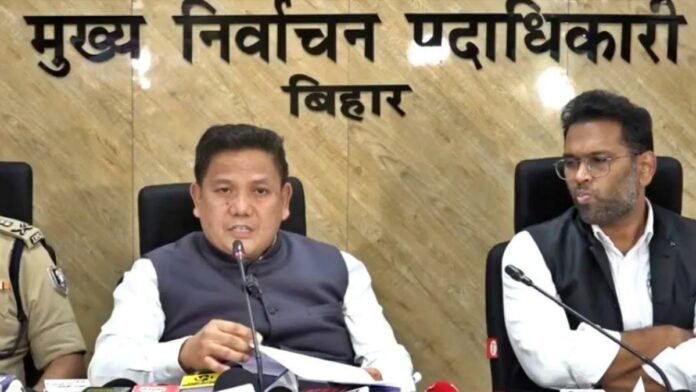
Key Points:
- First phase of 2025 Bihar Assembly elections concluded on November 6, 2025, across 121 of 243 constituencies
- Final voter turnout: 64.46%, highest in 30 years and 4.45% above 2020 first phase
- 37.5 million voters (19.8 million men, 17.6 million women) participated in 18 districts
- 1,314 candidates contested; reputations of 16 ministers including Tejashwi Yadav, Tej Pratap Yadav, and Deputy CM Samrat Choudhary at stake
- High-profile seats included Raghopur (RJD’s Tejashwi), Tarapur (BJP’s Samrat Choudhary), Mahua (Tej Pratap), and Alinagar (Singer Maithili Thakur)
Patna: The 64.46% voter turnout represents a watershed moment in Bihar’s electoral history, surpassing the previous 30-year benchmark and demonstrating exceptionally high voter engagement. The provisional figure, likely to marginally increase with final counts, already exceeds the entire 2020 election’s overall turnout of 57.47%, suggesting unprecedented voter enthusiasm despite the controversial Special Intensive Revision (SIR) that deleted approximately 47 lakh names from the electoral roll.
Political analysts view high voter turnout as traditionally indicating anti-incumbency sentiment, potentially benefiting the opposition Mahagathbandhan coalition led by RJD’s Tejashwi Yadav over Chief Minister Nitish Kumar’s ruling NDA. However, this pattern is not absolute the BJP has historically won elections with elevated turnouts since 2014. The first phase’s record engagement, combined with 121 remaining constituencies in the second phase (November 11), will ultimately determine whether turnout correlates with anti-incumbency or reflects broader democratic participation improvements.
District-by-District Performance: Begusarai Leads, Patna Lags
Significant variation emerged across the 18 districts participating in the first phase. Begusarai recorded the highest voter turnout at 67.32%, while Sheikhpura registered the lowest at 52.36% by 5:00 PM. Other strong-performing districts included Lakhisarai (46.37%) and Gopalganj (46.73%), while the capital city, Patna, consistently recorded sluggish turnout, just 37.72% by 1:00 PM, possibly reflecting urban voter apathy or access challenges.
The district-level disparities reflect diverse factors: rural enthusiasm, transportation accessibility, political polarization intensity, and local candidate prominence. Begusarai’s exceptional performance may indicate strong voter engagement with prominent candidates or heightened local political consciousness. Patna’s relatively weak turnout raises questions about urban voter mobilization and suggests campaign strategies may require strengthened urban outreach mechanisms for the second phase.
High-Profile Contests: Major Political Figures Face Voters
Several constituencies attracted national attention due to prominent candidates. Tejashwi Yadav, the Mahagathbandhan’s chief ministerial face, contested from Raghopur a seat traditionally held by his family. His contest symbolizes the broader NDA-Mahagathbandhan competition, with his performance serving as a barometer for opposition electoral strength. Simultaneously, Deputy Chief Minister Samrat Choudhary defended his Tarapur seat against RJD challenges, with 58.33% turnout recorded.
Tej Pratap Yadav, Tejashwi’s estranged brother, fought from Mahua on his Jan Shakti Janata Dal ticket, indicating a three-way ideological split within Bihar’s political landscape. Deputy Chief Minister Vijay Kumar Sinha contested Lakhisarai, where tensions reportedly emerged during his campaign. Folk singer Maithili Thakur’s candidacy from Alinagar on a BJP ticket attracted considerable media attention, representing a novel celebrity-politics intersection.
Women’s Participation: Strong Female Voter Enthusiasm
The Election Commission specifically commended robust female voter participation, noting 17.6 million women cast ballots in the first phase, comprising 47% of the 37.5 million total voters. This female representation exceeded conventional expectations, suggesting effective mobilization campaigns targeting women voters and increased political consciousness regarding gender participation. The high female turnout reflects broader social trends wherein women’s electoral engagement has progressively strengthened across Indian elections.
Female voter enthusiasm holds particular significance for parties like the RJD and Congress, which have campaigned aggressively around women-centric welfare schemes, including the promised “Ladki Bahini” scheme pledging ₹1,000 monthly stipends. Women’s electoral patterns may significantly influence final outcomes, potentially favoring opposition coalitions perceived as more women-focused in their policy frameworks.
Technical Performance: Minimal EVM Malfunctions and Rapid Resolution
The Election Commission reported substantially improved technical performance compared to the 2020 elections. EVM malfunctions declined markedly, with only 143 complaints received throughout the entire first phase across 121 constituencies, a remarkable technical achievement. The commission noted that all reported complaints were resolved promptly during voting hours, minimizing disruptions to voter participation.
This technical improvement reflects enhanced maintenance protocols, better infrastructure deployment, and learning from previous election experiences. The minimal malfunction rate generated voter confidence in the electoral process’s integrity and reduced concerns about technological failures compromising voting accuracy. Enhanced technical reliability strengthens democratic legitimacy by ensuring voters experience smooth polling experiences without technological frustrations.
Sporadic Incidents: Violence Remains Minimal Despite Political Tensions
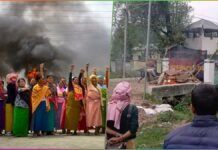
Police officials reported the first phase remained “completely peaceful” except for isolated incidents. Two notable incidents emerged: first, a scuffle in Halsi, Lakhisarai, involving a dispute over road conditions during Deputy Chief Minister Samrat Choudhary’s visit; second, a stone-throwing incident in Daudnagar, Saran, damaging MLA Dr. Satyendra Yadav’s vehicle windshield without causing injuries. Reports also mentioned tensions in Deputy Chief Minister Vijay Kumar Sinha’s convoy in Lakhisarai.
These limited violent incidents represent relatively restrained political behavior despite intense electoral competition and constitutional amendments following the SIR deleting 47 lakh voter names, a contentious action opposition parties alleged targeted poor and marginalized communities traditionally supporting them. The police’s success in containing tensions reflected intensive patrolling and proactive security deployments that prevented political hostilities from escalating into widespread disorder.
Security Measures: Weapon Seizures Contribute to Peaceful Elections
Since the Election Commission imposed the electoral code of conduct, authorities seized 850 illegal weapons and 4,000 cartridges, a substantial confiscation indicating a serious commitment to preventing armed violence during elections. These enforcement operations substantially contributed to the first phase’s peaceful electoral environment, removing potential tools for organized political violence and intimidation.
The weaponry seizures demonstrate rigorous security protocols wherein law enforcement agencies proactively disarm potential perpetrators rather than relying solely on reactive policing. This preventive security approach has become increasingly sophisticated in Indian electoral processes, directly contributing to maintaining democratic order during high-stakes political competitions.
Structural Context: Three-Way Contest and Electoral Dynamics
The 2025 Bihar elections represent a three-cornered contest featuring the ruling NDA (BJP-JDU alliance), the opposition Mahagathbandhan (RJD-Congress), and Prashant Kishor’s newly emergent Jan Suraaj Party making its electoral debut. This multifaceted competition complicates traditional binary electoral analysis and introduces unpredictability regarding vote consolidation patterns. The second phase (November 11) will provide additional insights into vote distribution and coalition strength.
Results scheduled for November 14 will determine whether the NDA secures a third consecutive term under Nitish Kumar or whether the Mahagathbandhan, potentially led by Tejashwi Yadav as chief minister, captures power. The historically high first-phase turnout has energized both alliances while creating uncertainty regarding outcomes.