





























Key Points
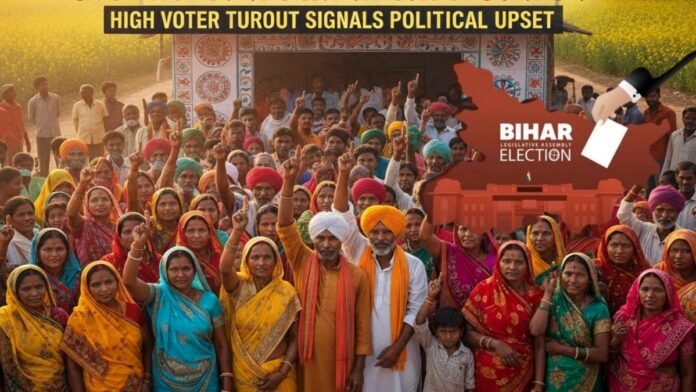
- The first phase of the Bihar elections on 121 seats recorded an unprecedented 64.46% voter turnout.
- This is a substantial increase from the 55.68% turnout recorded in the first phase of the 2020 elections.
- Historically, a swing in voter turnout of over 5% in Bihar has often led to a change in government.
- The second and final phase of polling for the remaining 122 seats will take place on November 11, 2025.
New Delhi: The first phase of the Bihar Assembly elections concluded with a remarkable 64.46% voter turnout across 121 constituencies. This figure represents a new record for the state and a sharp increase compared to the 55.68% turnout seen in the 71 seats of the first phase in 2020. Political analysts are now closely watching to see if this high level of voter engagement persists in the second and final phase on November 11. If it does, Bihar could be on the cusp of a major political realignment, a pattern strongly supported by electoral data from the past seven decades.
Bihar’s History of Turnout-Driven Change
An analysis of the 17 assembly elections held in Bihar since 1952 reveals a compelling trend: whenever voter turnout has increased or decreased by more than 5%, it has often resulted in a transfer of power and a significant shift in political dynamics.
| Year | Voting (%) | Increase/Decrease | Government Formed |
|---|---|---|---|
| 1952 | 39.5% | — | Congress |
| 1957 | 41.3% | +1.8% | Congress |
| 1962 | 44.5% | +3.2% | Congress |
| 1967 | 51.5% | +7.0% | Jan Kranti Dal (Change of Govt) |
| 1969 | 52.8% | +1.3% | Unstable Government |
| 1972 | 52.8% | +0.0% | Congress |
| 1977 | 59.0% | +6.2% | Janata Party (Post-Emergency) |
| 1980 | 57.3% | -1.7% | Congress (Change of Govt) |
| 1985 | 56.3% | -1.0% | Congress |
| 1990 | 62.0% | +5.8% | Janata Dal (Change of Govt) |
| 1995 | 61.8% | -0.2% | RJD (Stable Government) |
| 2000 | 62.6% | +0.8% | RJD |
| 2005 | 46.5% | -16.1% | JDU-BJP (Change of Govt) |
| 2010 | 52.7% | +6.2% | JDU-BJP |
| 2015 | 56.7% | +4.0% | JDU-RJD |
| 2020 | 57.3% | +0.6% | JDU-BJP |
Source: Election Commission of India
Landmark Elections That Shaped Bihar
- 1967: The First Non-Congress Government: A 7% surge in voter turnout led to the formation of the state’s first non-Congress government under the Jan Kranti Dal. Although the government was unstable, it marked the beginning of the Congress party’s decline in Bihar.
- 1990: The Rise of Lalu Yadav: An increase of 5.8% in turnout swept the Janata Dal to power, with Lalu Yadav becoming Chief Minister. This election, coupled with the Mandal Commission’s impact, permanently altered Bihar’s politics, leading to a 15-year rule for Lalu Yadav’s party.
- 2005: The End of the Lalu-Rabri Era: A dramatic 16.1% decrease in voter participation brought an end to the Lalu-Rabri regime. Nitish Kumar became Chief Minister, ushering in an era focused on “good governance” that has seen him dominate Bihar’s politics for two decades. This instance shows that even a sharp drop in turnout can signal a desire for change.
The Road to November 11
With the final phase of voting just days away, the record turnout has intensified the contest between the incumbent JDU-BJP coalition led by Chief Minister Nitish Kumar and the opposition alliance. While some political experts caution that a change in government is not guaranteed, they agree that such a high level of voter participation indicates a strong public mood that could completely transform the state’s political calculus, regardless of the final winner. The results will reveal whether the historic turnout was a vote for continuity or a mandate for a new political direction.