
































Key Points
- Approximately 40,45 tons of deadly methyl isocyanate gas leaked from Union Carbide plant on December 2,3, 1984
- Thousands died within three hours, over 500,000 people exposed to toxic gas
- Government records show 3,900 severely and permanently disabling injuries among survivors
- Faulty equipment, untrained workers, and disabled safety systems caused the disaster
- Toxic waste from the plant (337 metric tonnes) finally removed in January 2025 after 40 years
- Groundwater in 42 surrounding colonies remains contaminated with heavy metals and chemicals
- Survivors continue to face third and fourth generation health complications
- Union Carbide settlement of USD 470 million paid to Indian government in 1989
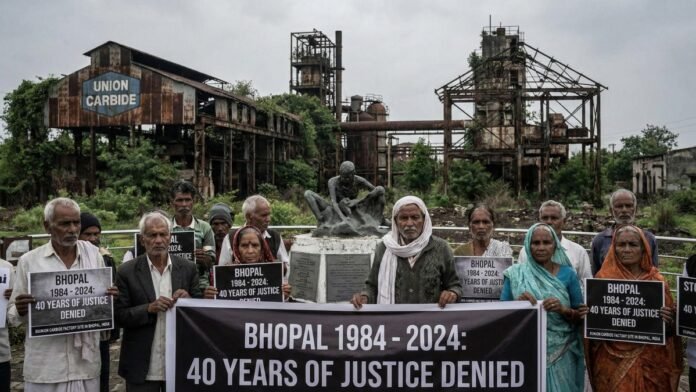
On the night of December 2, 1984, a dark chapter was forever etched into the pages of Indian history when nearly 40 tons of methyl isocyanate (MIC) gas escaped from the Union Carbide India Limited (UCIL) pesticide plant in Bhopal, Madhya Pradesh. The catastrophic gas leak exposed over 500,000 people in the vicinity, killed thousands instantly, and left countless survivors with permanent disabilities and chronic health problems that persist to this day. Four decades after the midnight nightmare, the Bhopal Gas Tragedy remains the world’s most devastating industrial accident, a stark reminder of corporate negligence and the human cost of prioritising profits over safety.
The Horrific Night Unfolds
Kushab Kaykar, a native of Vidarbha working at the Punjab National Bank branch in Old Bhopal during the tragedy, awoke at 12,45 am to the sound of people screaming and shouting in the darkness. Initially believing a riot had broken out, Kaykar rushed to his window on the third floor of his residence. The moment he opened it, violent coughing seized him, and he realised he was suffocating from an invisible killer. “I immersed my head in a bucket of water and repeatedly poured water over my nose and mouth,” Kaykar recalled. “This proved beneficial, and my life was saved.”
From his window, Kaykar witnessed a horrifying scene that would haunt him for the remainder of his life. Crowds of people ran frantically for safety, coughing violently, some vomiting uncontrollably, while others were wiping their eyes as the toxic gas irritated them mercilessly. The entire street was filled with vomit and human suffering. When Kaykar descended to the streets, people informed him of the toxic gas leak from the Union Carbide factory. “Hearing this, the ground beneath my feet slipped away,” he said, capturing the moment of realisation that a catastrophe of unimaginable proportions had occurred.
Three Hours of Mass Death and Suffering
The toxic gas leak commenced at 11,20 pm on December 2, 1984, and within three hours, by 2,16 am on December 3, the deadly methyl isocyanate cloud had completely engulfed the old Bhopal metropolitan area. The devastation was instantaneous and overwhelming. By 1,15 am, the 1,200-bed capacity of Bhopal’s Hamidia Hospital and Mahatma Gandhi Medical College was full with critically injured victims. Medical staff were entirely unprepared for the scale of casualties, and the healthcare system collapsed under the weight of human suffering.
Thousands of people fell victim to the toxic fumes within that terrible three-hour window, making it one of the deadliest industrial incidents in human history. The death toll official government records documented as over 3,000 immediate deaths, though survivor organisations and independent researchers suggest the actual number was substantially higher. Beyond those who died instantly, the government affidavit filed in 2006 stated that the leak caused approximately 558,125 injuries, including 38,478 temporary partial injuries and 3,900 severely and permanently disabling injuries that would define the remainder of the victims’ lives.
Root Causes, Corporate Negligence and Safety Failures
Investigations into the disaster revealed that the tragedy was entirely preventable and resulted from calculated corporate negligence rather than unforeseen circumstances. According to official investigations, faulty equipment and undertrained workers at the plant contributed directly to the catastrophe. Critically, Union Carbide Corporation (UCC) admitted in their own investigation report that most of the safety systems were not functioning on the night of December 3, 1984, a reality that Union Carbide had knowingly maintained.
A significant contributing factor was the malfunction of the MIC tank pressure gauge, which had been inoperative for approximately one week before the disaster. Instead of repairing the faulty gauge, plant operators used alternative tanks to bypass the problem, a cost, cutting measure that would prove catastrophic. The buildup in temperature and pressure resulting from this negligence directly affected the magnitude of the gas release. The disaster was not an accident but the direct result of deliberate safety violations, ignored warnings, and systemic failures designed to prioritise operational efficiency and financial savings over human lives.
The Long-Term Legacy and Ongoing Contamination
Four decades after the gas tragedy, the environmental contamination resulting from the Union Carbide plant continues to devastate the region. The original Union Carbide factory site remains contaminated, continuously leaking poisons into the soil and groundwater of surrounding areas. According to the Indian Institute of Toxicology Research, groundwater in at least 42 colonies around the plant contains dangerous levels of nitrates, chlorides, heavy metals, and alpha-naphthol, a chemical directly linked to the production of methyl isocyanate.
The toxic waste from the defunct Union Carbide India Ltd factory finally departed the site after 40 years, on January 1, 2025, marking a significant milestone. A total of 337 metric tonnes of hazardous waste was transported in 12 containers across 250 kilometres to the Pithampur industrial area in Dhar district, where incineration procedures were to be conducted. The waste was packed under stringent security supervised by the Madhya Pradesh Pollution Control Board, representing the first major cleanup effort at the original site in four decades. However, independent researchers and activists have raised serious concerns about whether moving the waste to Pithampur adequately addresses the disaster’s toxic legacy or merely creates a new “sacrifice zone.”
Generations Continue Suffering Health Consequences
The suffering from the Bhopal Gas Tragedy has not been limited to those who directly experienced the gas exposure on that horrific December night. Generations of survivors and their descendants continue to suffer chronic health complications decades after the disaster, including respiratory diseases, eye problems, immune system disorders, and reproductive health issues. Children born to survivors have inherited health vulnerabilities, and medical evidence suggests that third and fourth-generation descendants continue to experience health consequences.
Survivor accounts reveal the ongoing physical and psychological trauma of the disaster. Kushab Kaykar, who managed to survive the initial exposure through his quick actions that night, was eventually transferred to Chandrapur but carries permanent emotional scars. “Even today, remembering the incident sends chills down my spine,” Kaykar reflected, capturing the enduring psychological impact of the tragedy. The healthcare burden on the Bhopal region remains substantial, with specialised medical services required to treat the complex health conditions resulting from MIC gas exposure.
Justice and Corporate Accountability
In 1989, after years of legal battles, Union Carbide Corporation settled with the Indian government for USD 470 million, which equated to approximately USD 500 per affected person. Survivor advocates and human rights organisations have consistently argued that this compensation is grossly inadequate and fails to address the lifetime medical costs and loss of livelihood experienced by survivors. The settlement amount, while substantial in nominal terms, failed to provide true justice or adequate reparations for the world’s worst industrial disaster.
Furthermore, accountability has remained limited. In 2001, Dow Chemical acquired Union Carbide and has since denied responsibility for further compensation or cleanup of the contaminated site, arguing that it did not own the company at the time of the accident. Meanwhile, Union Carbide Corporation (UCC) and its parent company have been criticised for withholding critical information regarding MIC’s toxicological properties and the full nature of the chemicals that leaked during the disaster, undermining medical response efforts from the beginning. International human rights organisations and survivor groups continue to demand that corporations responsible for the tragedy face genuine accountability and provide appropriate compensation to affected communities.
Ongoing Memorialization and Lessons for Industrial Safety
As the world marked the 40th anniversary of the Bhopal Gas Tragedy in December 2024, survivor organisations undertook international awareness tours to build support for justice and accountability. The tragedy serves as a critical lesson in the dangers of corporate negligence, regulatory failures, and the prioritisation of profit over human safety in industrial operations worldwide. The Bhopal disaster fundamentally changed industrial safety protocols and led to increased emphasis on corporate accountability in hazardous chemical operations across the globe.
Yet despite these reforms, the Bhopal survivors continue their fight for justice, adequate healthcare, and environmental remediation. The removal of toxic waste from the site in January 2025 represents progress, but true justice and comprehensive environmental cleanup remain elusive. The legacy of Bhopal serves as a powerful reminder that industrial development and chemical manufacturing must never come at the cost of human lives and environmental health, and that corporations must be held accountable for the consequences of negligence and cost-cutting measures that endanger communities.