
































Key Highlights
- Record Shattered: The crew traveled approximately 406,771 kilometers from Earth, surpassing the long-standing record set by Apollo 13 in 1970.
- Historic Flyby: This mission marks the first time humans have entered the Moon’s “sphere of influence” since the Apollo 17 mission in 1972.
- Far Side Maneuver: Astronauts emerged from a 40-minute communications blackout after orbiting the lunar far side to begin their return journey.
- Emotional Tributes: The crew proposed naming two lunar craters “Integrity” and “Carroll” to honor their spacecraft and the late wife of Commander Reid Wiseman.
- Return Schedule: The Orion capsule is currently on a high-speed trajectory back toward Earth, with splashdown expected on April 10, 2026.
The Artemis II mission, launched by NASA on April 1, 2026, has achieved a monumental milestone in human spaceflight. On Monday, April 6, the four-person crew officially broke the human distance record from Earth, previously held by the ill-fated Apollo 13 mission, which reached 400,171 kilometers in 1970. Reaching a peak distance of roughly 406,771 kilometers, the Orion spacecraft, named “Integrity” by its crew, pushed further into the cosmos than any human-carrying vessel in history.
This mission serves as the first crewed flight of the Artemis program, designed to test the Space Launch System (SLS) and the Orion capsule’s life-support systems before humans attempt a landing at the lunar South Pole. The crew consists of Commander Reid Wiseman, Pilot Victor Glover, and Mission Specialists Christina Koch and Jeremy Hansen, the latter being the first Canadian to venture to the Moon.
The Critical “Far Side” Phase
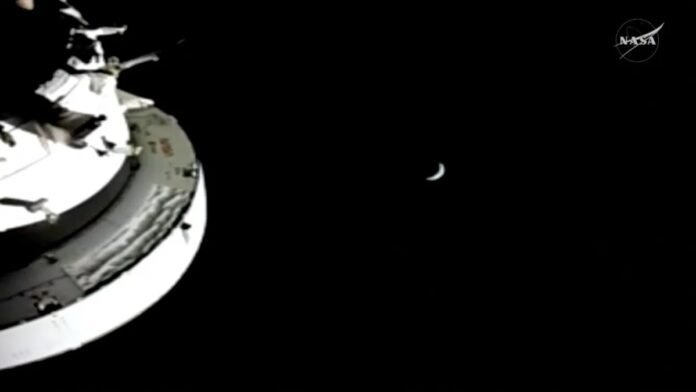
One of the mission’s most intense segments occurred as Orion slipped behind the Moon, cutting off all radio communication with Mission Control for approximately 40 minutes. During this period, the astronauts became the first humans to observe the lunar far side with the naked eye in over half a century.
Canadian astronaut Jeremy Hansen described the experience as surreal, noting that seeing the lunar surface with such clarity, without the aid of magnification or instruments, was “unbelievable.” Mission Pilot Victor Glover captured high-resolution imagery featuring both the Earth and the Moon in a single frame, remarking that the brilliance of the lunar mountains made them appear as if they were blanketed in snow.
Emotional Tributes and Scientific Legacy
Following the record-breaking moment, the mission took an emotional turn. The crew was requested to name two relatively fresh lunar craters observed during their flyby. They proposed the name “Integrity” for one, and “Carroll” for the other, in memory of Commander Reid Wiseman’s late wife, Carroll Taylor Wiseman, who passed away in 2020. The request, relayed by Hansen to Mission Control, was met with visible emotion from the crew, who shared a brief moment of reflection and a group embrace while floating in the cramped capsule.
Looking Toward Splashdown
As of April 7, 2026, the crew has successfully executed the engine burns required to slingshot Orion back toward Earth. While the mission has faced minor technical hurdles, including intermittent issues with the onboard waste management system and early communications glitches, NASA officials confirm that all primary life-support systems are functioning optimally.
The mission is a crucial precursor to Artemis III and IV, which aim to land the first woman and the first person of color on the lunar surface within the next two years. For now, the focus remains on the high-stakes reentry through Earth’s atmosphere, with a planned splashdown in the Pacific Ocean near San Diego scheduled for Friday, April 10.