



































Key Points
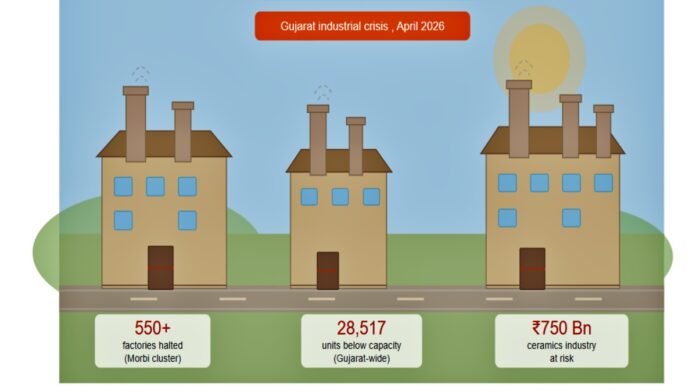
- Over 1,212 industrial units in Gujarat have shut completely, while 28,517 more are operating well below capacity.
- Of Morbi’s 670 ceramic factories, nearly 450 have stopped operations, with the shutdown linked to the closure of the Strait of Hormuz following the US-Israel conflict with Iran.
- Surat’s textile hub is losing an estimated Rs 100 crore every single day, with factories cutting hours as petrochemical-derived materials grow sharply more expensive.
- Morbi factories began a phased restart after the government increased natural gas allocation on April 8, but manufacturers now face price hikes of 15–25% to offset losses.
- The state government has approved investment-linked assistance worth more than Rs 1,607 crore for 23 industrial units, expected to generate around 5,634 jobs.
Walk through the sprawling ceramic clusters of Morbi or the textile lanes of Surat today, and the stillness is unmistakable. Gujarat, often called the engine of India’s economy, is battling one of its most serious industrial disruptions in recent memory, one triggered not by any domestic policy failure, but by a war unfolding thousands of kilometres away.
The West Asia conflict, set off when US and Israeli forces struck Iran on 28 February, effectively closed the Strait of Hormuz, a vital energy corridor for vessels. That closure has severed the propane supply lifeline on which Gujarat’s ceramic factories overwhelmingly depend. Propane travels from Saudi Arabia and other Gulf nations by sea to Kandla port in Gujarat, and then by tanker to factories across Morbi, roughly 130 km away. With those shipments severely disrupted, the consequences have been swift and severe.
Morbi: The World’s Ceramic Capital Counts Its Losses
Morbi houses around 1,200 ceramic units producing nearly 60 lakh tonnes annually and providing employment to about nine lakh people. The cluster accounts for 80 to 90 per cent of India’s ceramic exports and recorded export revenue of approximately Rs 15,000 crore in 2024–25.
The town has seen most of its factories shut for nearly a month after gas supplies tightened sharply in the wake of the Iran war. About 550 factories have halted production, while only a few using piped natural gas remain operational, depending on availability.
Gas consumption in Morbi has collapsed from roughly 30 to 35 lakh cubic metres per day down to just 4.5 lakh. Orders from Gulf and African buyers have dried up, and with fuel and raw material costs rising sharply, many manufacturers simply cannot afford to keep the kilns burning.
At a special industry meeting, Morbi Ceramic Manufacturing Association president Manoj Arvadiya confirmed that around 430 units collectively decided to shut down, using the enforced downtime for machine maintenance. He said propane-dependent units were the first to halt after supplies were exhausted, followed by those dependent on natural gas. They committed to restarting operations only once fresh gas supplies become available.
Surat, Jamnagar, Rajkot: The Crisis Spreads
The disruption is far from confined to ceramics. Surat’s textile sector is grappling with declining exports, with processing units shifting to single-shift operations and observing two weekly closure days. Chemical units in Ankleshwar and Vapi are facing increased production costs, while the diamond industry has seen a sharp drop in exports. The rubber sector has been hit by a reported 40 to 50 per cent rise in raw material costs. In Jamnagar, the brass parts industry has halted operations, and engineering exports from Rajkot have been significantly affected.
The hospitality sector too is under strain, with hotels and catering services experiencing limited availability of commercial gas cylinders. Gujarat’s manufacturing sector, particularly its MSME base, employs over two million workers, making the human cost of this disruption enormous.
Workers Bear the Sharpest Blow
For migrant workers like Radhe, a daily wage labourer from Bihar’s Purnia district who came to Morbi seeking the steady work his village could not offer, the crisis has been devastating. In normal times, he earned Rs 16,000 a month. That has since fallen sharply, and by mid-March, even that income had vanished. “If we don’t get our salary, we will have to go back home,” the 34-year-old said.
Government Response: Denial, Then Action
The state government initially downplayed the situation. Industry Commissioner K.C. Sampat attributed the slowdown to logistics and supply chain disruptions rather than an energy crisis, denying the existence of large-scale layoffs or worker exodus. However, the ground reality compelled stronger action.
With coordinated policy measures, diversified sourcing, and infrastructure support, Gujarat has moved to contain the impact of global energy disruptions. Authorities directed city gas distribution entities to prioritise connections for critical institutions. Officials confirmed that no CNG stations have shut down, with daily consumption supporting over 7.5 lakh vehicles. Adequate LNG supplies are being maintained through terminals at Mundra and Dahej, with additional cargo scheduled in the coming months.
On the pricing front, Gujarat Gas announced revised gas prices for April 2026, but the move has created fresh distress. Units that had been using propane and are now switching to pipeline gas have been classified as new customers, with gas priced at Rs 94 per unit, compared to Rs 70 per unit for existing customers. Industrialists have demanded immediate government intervention to rationalise these rates, warning that the price gap could threaten the future of the entire ceramic sector.
A Fragile Recovery Begins
Morbi’s factories are returning to operation after the government increased natural gas allocation on April 8. However, the sector’s recovery is complicated by the need for significant price adjustments. Manufacturers anticipate price hikes of 15 to 25 per cent to cover losses from the shutdown and rising fuel, transport, and logistics costs.
Branded players such as Kajaria Ceramics and Somany Ceramics used the disruption period to capture greater market share. As full production capacity returns, Morbi’s smaller units are expected to push volume aggressively to recover losses, which could squeeze margins across the sector.
Separately, the Gujarat government has approved investment-linked financial assistance worth more than Rs 1,607 crore for 23 industrial units across multiple districts, a move expected to generate an estimated 5,634 jobs.
The Wider Question
Gujarat contributes roughly 8 per cent of India’s GDP and nearly 22 per cent of its manufacturing output. A sustained industrial slowdown here carries real consequences for the national economy, from export revenues to employment. While the partial restart of Morbi factories signals cautious optimism, the ceramic industry’s vulnerability to global energy shocks, a dependency built over decades, remains unaddressed. Until gas supply chains stabilise and pricing rationalisation follows, the kilns in Gujarat’s industrial heartland will continue to burn low.