



































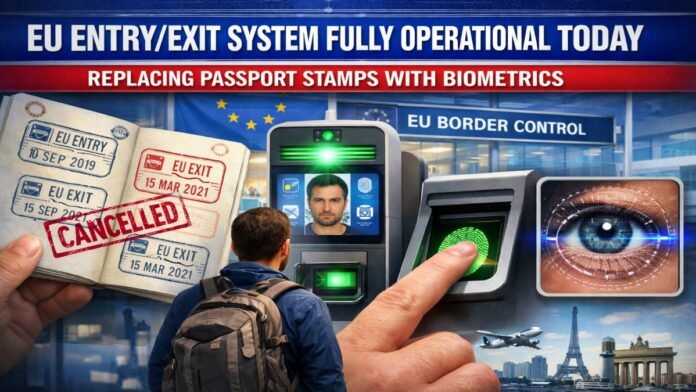
Key Points
- Live Today: As of April 10, 2026, the EES is fully live across 29 European countries, marking the end of a phased rollout that began in late 2025.
- Biometric Focus: Manual stamps are replaced by facial scans and fingerprint data for non-EU nationals staying up to 90 days.
- Exceptions: Ireland and Cyprus will continue manual passport stamping for now and are not yet part of the EES network.
- Data Storage: Personal and biometric data will be stored securely for three years, or until a traveler’s passport expires.
- Future Readiness: The EES is a precursor to the ETIAS (European Travel Information and Authorisation System), which is slated for launch in late 2026.
For millions of tourists planning a European summer, the traditional ink stamp in a passport is now a relic of the past. Today, April 10, 2026, the European Union officially marked the full implementation of its Entry, Exit System (EES), a sophisticated biometric border management tool. Designed to modernize security and streamline traffic, the system digitally records the entry and exit of all non-EU travelers visiting the Schengen Area for short stays of up to 90 days within any 180 days.
The European Commission’s Directorate General for Migration and Home Affairs confirmed that this shift is part of a broader effort to strengthen border security. By replacing manual stamps with digital records, authorities can now automatically calculate the duration of a visitor’s stay with total arithmetic certainty, making it easier to detect overstayers and combat identity fraud.
How the Process Works
Upon your first entry into a participating EU country from today onward, the system will be activated at the border checkpoint. Travelers will no longer wait for a stamp; instead, border authorities will capture biometric data, including:
- A high-resolution facial image for recognition software.
- Fingerprint scans (required for all travelers aged 12 and over).
These details are linked to the traveler’s passport information and stored in a central database. On subsequent visits within the three-year validity period, travelers can expect faster identity verification at self-service kiosks, as the system will only need to verify existing biometric data rather than perform a full capture.
Travel Tips for a Smoother Arrival
While the EES is designed for long-term efficiency, the initial “go, live” phase may see slightly longer processing times at busy hubs like Paris Charles de Gaulle or Frankfurt Airport. To navigate the new requirements, travel experts recommend several proactive steps:
- Use the “Travel to Europe” App: Travelers can upload their passport information and a facial photo via the official mobile app up to 72 hours before arrival. While final biometric checks still occur at the desk, this prep work can significantly reduce time spent with border officers.
- Arrive Early: Especially during this launch month, allow extra time for connections. The system is still being calibrated at various land and sea borders, including the high, traffic UK, France crossing points.
- Verify Eligibility: Remember that children under 12 are exempt from providing fingerprints but must still undergo a facial scan.
EES vs. ETIAS: What’s Next?
Travelers must distinguish between the EES and the upcoming ETIAS. While the EES, launched today, is a border check system, the ETIAS will be a pre-travel authorization similar to the U.S. ESTA. Current reports indicate that the ETIAS will not be mandatory until the fourth quarter of 2026. For now, the primary change is the digital record of your movement at the physical border.
By adopting these digital measures, the EU aims to reduce manual errors and improve overall efficiency during peak travel seasons. For the informed traveler, the EES provides a higher level of predictability and security, ensuring that your European summer remains focused on the destination rather than the paperwork.