































Key Developments
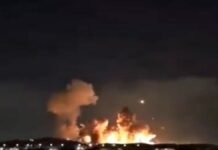
- Conflict Milestone: The joint U.S.-Israeli campaign, dubbed “Operation Epic Fury,” reaches its 34th day with significant Iranian infrastructure reported destroyed.
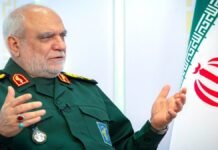
- Leadership Losses: Confirmation of the deaths of several top Iranian officials, including claims regarding the neutralization of the regime’s command structure.
- Strait of Hormuz: President Trump demands regional allies take the lead in securing the waterway, citing a 60% drop in regional oil exports.
- Nuclear Program: Strategic strikes have targeted enrichment facilities to permanently “neuter” Tehran’s atomic capabilities.
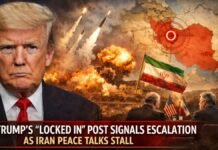
- Two-Week Window: The White House warns of intensified strikes over the next 21 days to “finish the job” regardless of ongoing back-channel communications.
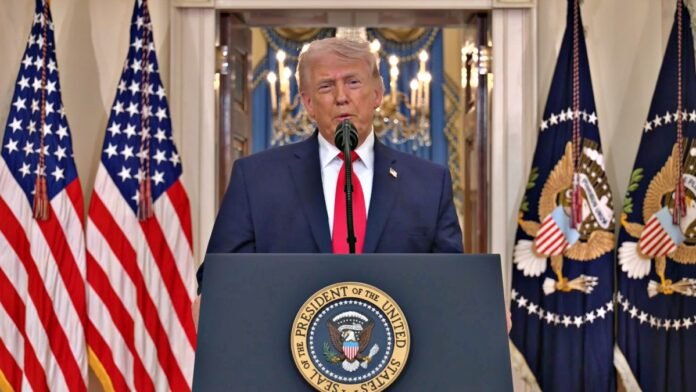
Addressing the nation from the White House on April 1, 2026, President Donald Trump commended the military’s “overwhelming victories” in a conflict that has reshaped Middle Eastern geopolitics. The President asserted that the U.S. military has dealt a definitive strike against the Iranian regime, significantly undermining its ability to project power.
The conflict has now entered its 34th day, and fears are mounting that the situation could deteriorate further if a diplomatic exit isn’t found. However, Trump remained focused on the degradation of Tehran’s assets, claiming that its missile, drone, and naval capabilities have sustained severe, and in many cases irreparable, damage. He reiterated the administration’s red line, the United States will not allow Iran to become a nuclear power, and noted that Israel and the U.S. have worked in tandem throughout the month-long operation to dismantle the Islamic Republic’s nuclear infrastructure.
The Objectives: “Operation Epic Fury”
The U.S. President clarified that the objective of this campaign is not to seize control of Middle Eastern oil, but rather to prevent Iran from developing nuclear weapons and continuing its “energy blackmail.” According to the administration, the primary goals of the operation are:
- Neutralizing Threats: Eliminating forces and proxies that pose a direct threat to U.S. interests.
- Maritime Superiority: Destroying Iran’s naval and air forces to ensure freedom of navigation.
- Nuclear Disarmament: Eliminating the capacity to develop atomic weapons and ending state-sponsored terrorism.
While the President claimed these objectives have, to a significant extent, already been achieved, the humanitarian and economic toll continues to rise. Global oil prices have spiked as the Strait of Hormuz remains a primary “choke point” for international trade.
Burden-Sharing in the Strait of Hormuz
In a characteristically transactional move, President Trump stated that nations dependent on oil supplies passing through the Strait of Hormuz must now assume the responsibility for its security. While the United States stands ready to offer assistance, Trump insisted that the leadership role must be undertaken by those very nations that are heavily reliant on the oil.
Offering a blunt solution to the energy crisis, Trump suggested that allies should first buy oil from the United States, as “we have no shortage of it,” and second, “demonstrate courage.” He urged regional partners like Saudi Arabia, the UAE, and Bahrain to join forces with the U.S. to enter the Strait, ensure its security, and utilize it in their own interests. This step should have been taken long ago, he noted, signaling a shift toward regional “burden-sharing” that has become a hallmark of his 2026 foreign policy.
Escalation or Conclusion?
Despite the talk of victory, the conflict appears far from a quiet end. Trump signaled that in the coming weeks, the United States could intensify its military actions against Iran, even if behind-the-scenes negotiations through intermediaries like Pakistan continue.
“In the next two to three weeks, we could strike them hard,” Trump remarked, suggesting that the remaining oil and industrial infrastructure could be targeted next. While he clarified that diplomatic options remain open, the rhetoric remains focused on a “swift and decisive” conclusion. As the world watches the 34th day of hostilities, the question remains whether this final push will lead to the “stone age” Trump warned of, or a stabilized, albeit radically different, Middle East.