






























Key Highlights
- Confirmed Fatalities: Iranian state media and the judiciary have confirmed the deaths of Supreme Leader Ayatollah Ali Khamenei, IRGC Commander Mohammad Pakpour, and security advisor Ali Shamkhani.
- Succession Mechanism: The 88-member Assembly of Experts is legally mandated to select the next leader, a process currently complicated by the ongoing 12-day conflict.
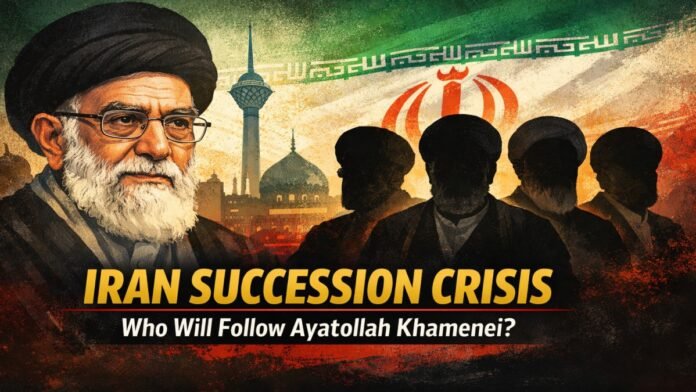
- Lead Contenders: Mojtaba Khamenei, son of the late leader, and Hassan Khomeini, grandson of the Republic’s founder, are the primary figures in an intensifying power struggle.
- Mourning Period: A 40,day national mourning period and a seven,day public holiday have been declared to stabilize the domestic front.
- Military Shadow: The Islamic Revolutionary Guard Corps (IRGC) is expected to act as the ultimate kingmaker, despite the loss of its top commander in the Saturday strikes.
The death of Ayatollah Ali Khamenei on February 28, 2026, has thrust the Islamic Republic into a historic leadership vacuum. For over 36 years, Khamenei served as the final arbiter of Iranian domestic and foreign policy, but his sudden removal during the “Epic Fury” aerial campaign has left the clerical establishment scrambling. Under the principle of “Vilayat,e, Faqih” (Guardianship of the Jurist), the next leader must be a high-ranking religious scholar, yet no single figure currently commands the absolute authority Khamenei once held.
While the Iranian constitution provides a roadmap for succession, the reality on the ground is far more complex. The Assembly of Experts, a body of 88 clerics, must now deliberate while the country is under active military bombardment and facing a potential internal uprising.
The Frontrunners: Legacy vs. Popularity
Two prominent names have emerged at the center of the transition debate. Mojtaba Khamenei, the 56, year old son of the late leader, has long been viewed as the “shadow” power within Tehran. His close ties to the security apparatus and his father’s inner circle make him a natural choice for those seeking continuity and regime survival. However, his appointment would face criticism from those who view a hereditary transition as a betrayal of the 1979 Revolution’s anti-monarchical roots.
In contrast, Hassan Khomeini, the grandson of Ayatollah Ruhollah Khomeini, remains a popular figure among reformists and the general public. While he possesses the revolutionary lineage, his moderate leanings have previously led to his disqualification from political roles by the Guardian Council. The current crisis may force the clerical establishment to choose between a hardline loyalist like Mojtaba or a more unifying figure like Hassan to prevent domestic collapse.
The Decisive Role of the IRGC
The Islamic Revolutionary Guard Corps (IRGC) remains the most powerful institutional force in Iran. Historically, the Guard has operated outside the jurisdiction of the elected government, answering only to the Supreme Leader. The loss of Major General Mohammad Pakpour, the IRGC’s top commander, in the same strike that killed Khamenei has created a temporary internal command crisis.
Analysts believe the IRGC will likely prioritize a successor who guarantees their continued economic and political dominance. “The Revolutionary Guards are not just a military force; they are the backbone of the state economy,” noted one regional expert. Their influence over the Assembly of Experts will be the deciding factor in whether Iran takes a more pragmatic path or doubles down on its “Axis of Resistance” ideology.
Regional Instability and the Pezeshkian Administration
As the transition unfolds, President Masoud Pezeshkian is leading a temporary triumvirate council to manage daily state affairs. Although considered a moderate, Pezeshkian’s influence is severely limited by the “Vilayat,e, Faqih” system, which places religious authority above the presidency.
The global community, particularly India and other major energy consumers, remains on high alert. With the Strait of Hormuz effectively closed and retaliatory strikes hitting targets across the Gulf, the speed and nature of Iran’s succession will determine if the Middle East descends into a prolonged continental war or finds a path toward a fragile new status quo.