


































Key Points
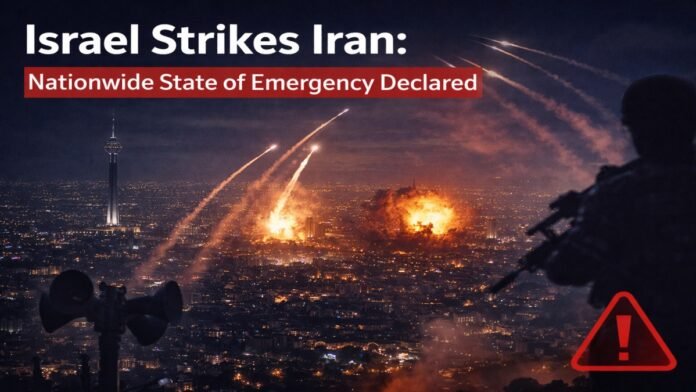
- Israel conducted a “preemptive” drone and missile strike against targets in Tehran to neutralize perceived security threats.
- Defense Minister Israel Katz declared a special nationwide state of emergency under the Civil Defense Law.
- Explosions and thick smoke were reported in downtown Tehran, particularly near the offices of the Supreme Leader.
- The IDF has suspended all educational activities, large gatherings, and non-essential workplaces across Israel.
- Sirens and cellular alerts have been triggered nationwide, with citizens instructed to stay near safe rooms.
In a dramatic escalation of regional tensions on Saturday, February 28, 2026, Israel launched a daylight military strike against Iran. Defense Minister Israel Katz described the operation as a preemptive strike designed to remove threats against the State of Israel. The announcement followed reports of massive explosions and thick plumes of black smoke rising from downtown Tehran, specifically in the Jomhouri district near the offices of Supreme Leader Ayatollah Ali Khamenei.
Immediately following the strike, Minister Katz exercised his powers under the Civil Defense Law to impose a special state of emergency on the home front across the entire country. This legal status grants the government and the military expanded authority to issue binding safety directives to the civilian population. Katz warned that an Iranian response, likely involving ballistic missiles and drone swarms, is expected in the immediate future.
IDF Mobilizes and Home Front Command Alerts
The Israel Defense Forces, or IDF, have moved the country to a wartime footing. All schools, universities, and non-essential workplaces have been shuttered, and public gatherings have been strictly prohibited to minimize potential casualties. Sirens sounded across major Israeli cities, including Tel Aviv and Jerusalem, as part of a proactive alert system intended to ensure citizens were already in or near fortified shelters before any retaliatory projectiles entered Israeli airspace.
Civilian airspace has been significantly restricted, and the government has appealed to all citizens to keep their cellular devices fully charged and within reach for real-time emergency updates. The IDF confirmed that these alerts were a preventative measure, designed to prepare the public for the high probability of long-range missile launches from Iranian territory.
Strategic Context and Retaliatory Risks
Iranian state media acknowledged the explosions in the capital but has yet to issue a formal military or political response. However, regional analysts suggest that Tehran is unlikely to remain passive, especially given the daylight nature and central location of the strikes. International diplomatic missions, including the U.S. State Department, had already authorized the departure of non-emergency personnel from the region on Friday, February 27, citing significant security risks.
The situation remains fluid as both nations brace for what could be a prolonged and direct military confrontation. The Israeli government has urged all residents to strictly monitor Home Front Command updates and to remain vigilant as the state of emergency remains in effect indefinitely.