

































Key Points
- Event Type: An annular solar eclipse, where the Moon creates a glowing ring around the Sun.
- India Timing: The phenomenon begins at 3:26 PM IST and concludes at 7:57 PM IST.
- Visibility: Best viewed in Antarctica, while parts of South Africa and South America will see a partial eclipse.
- No Sutak Kaal: Religious activities in India remain unaffected as the eclipse is not visible locally.
- Astrological Shift: The eclipse takes place in Aquarius and the Dhanishtha Nakshatra.
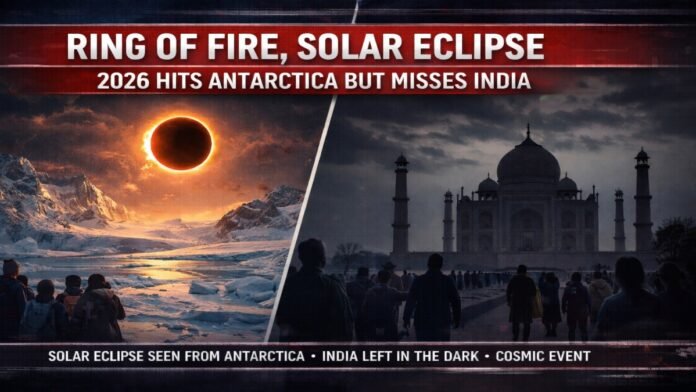
On Tuesday, February 17, 2026, the world will witness its first major astronomical event of the year, an annular solar eclipse. Scientifically termed as an “annulus,” this occurs when the Moon is at its farthest point from Earth, making it appear slightly smaller than the Sun. As the Moon passes directly in front of the star, it fails to cover it completely, leaving a brilliant, fiery outer edge visible, popularly known as the “Ring of Fire.”
While the event is a significant milestone for astronomers, skywatchers in India will miss the live spectacle. The path of the eclipse is centered almost entirely over the remote regions of Antarctica and the Southern Ocean, meaning the Sun will already be below the horizon in India by the time the peak phase occurs.
Timing and Religious Significance in India
According to Indian Standard Time, the eclipse is scheduled to begin at 3:26 PM, reach its maximum phase at approximately 5:42 PM, and finally end at 7:57 PM. The total duration of the event will be 4 hours and 31 minutes.
In Hindu tradition, solar eclipses typically trigger a “Sutak” period, a time of spiritual cleansing and restriction that usually begins 12 hours before the eclipse. However, because the February 17 eclipse is not visible from any part of India, experts and priests have clarified that no Sutak Kaal will be observed. This means that temples will remain open, and daily rituals, including cooking and eating, can proceed without the traditional restrictions often associated with such celestial events.
Astrology: Impact on Aquarius and Dhanishtha
While the physical shadow misses India, the astrological impact is being closely watched. The eclipse occurs on Falgun Amavasya in the zodiac sign of Aquarius, which is ruled by Saturn. Specifically, it falls under the Dhanishtha Nakshatra, a constellation associated with wealth and rhythm.
Astrologers point to a rare conjunction of five planetary bodies, the Sun, Moon, Rahu, Mercury, and Venus, all gathering in Aquarius during the event. While this is seen as an inauspicious combination for some, it is also considered a time for deep internal reflection and reorganization of long-standing life patterns.
Global Visibility and Future Events
For those located in the Southern Hemisphere, the view will be quite different. Residents in Cape Town, Durban, and parts of Zimbabwe and Tanzania will witness a partial eclipse. In Antarctica, the full “Ring of Fire” will last for approximately 2 minutes and 20 seconds.
If you are hoping to see an eclipse from India soon, the next major opportunity arrives with a total lunar eclipse on March 3, 2026, which will be visible across much of the country. For the next solar event, Indian observers may need to wait for future cycles as the shadow of the February 17 event remains firmly rooted in the southern latitudes.