

































Key Points
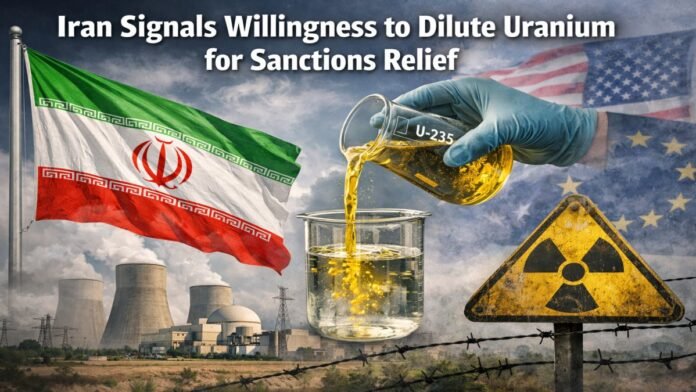
- Strategic Offer: Mohammad Eslami stated that the dilution of 60% enriched uranium depends entirely on the comprehensive removal of “cruel” sanctions.
- Oman Dialogue: The proposal follows the first indirect US-Iran talks in Muscat since the June 2025 military strikes on Iranian nuclear facilities.
- Nuclear Redlines: Foreign Minister Abbas Araghchi reaffirmed that domestic uranium enrichment is non negotiable and that ballistic missile programs remain strictly off the table.
- Security Mission: Ali Larijani, Secretary of the Supreme National Security Council, arrives in Oman on Tuesday to negotiate the framework for upcoming rounds of talks.
- Trust Deficit: Despite President Masoud Pezeshkian calling the dialogue a “step forward,” Tehran cited a deep “wall of mistrust” fueled by continued US sanctions and regional military deployments.
A major diplomatic shift is emerging in the long standing nuclear standoff between the United States and Iran. On Monday, February 9, 2026, the head of the Atomic Energy Organization of Iran, Mohammad Eslami, indicated that Tehran could seriously consider reducing its stockpile of 60% enriched uranium. Speaking to state media, Eslami clarified that such a move is “intrinsically linked” to the total lifting of international and US sanctions that have crippled the Iranian economy.
This gesture is seen as the first tangible outcome of indirect negotiations that resumed in Muscat, Oman, last Friday. These talks were the first high level engagements since the June 2025 conflict, during which the United States and Israel conducted targeted strikes on Iranian nuclear sites at Fordo, Natanz, and Isfahan.
The “Wall of Distrust” and Araghchi’s Conditions
While the Omani mediation has provided a platform for dialogue, Iranian Foreign Minister Abbas Araghchi has struck a cautious tone. Addressing diplomats in Tehran, Araghchi emphasized that while Iran is serious about a “win,win” outcome, no meaningful progress can occur under the shadow of military pressure. He noted that the arrival of the USS Abraham Lincoln in the Arabian Sea and the presence of US Central Command (CENTCOM) officials at the negotiating table have only reinforced the “wall of distrust” between the two nations.
Araghchi specifically pointed to the US behavior over the past year as the primary obstacle, stating that negotiations cannot be held while Washington continues to expand its “maximum pressure” campaign through new oil sanctions and tariff threats.
Missile Program Remains a Non,Starter
A significant hurdle remains the scope of the negotiations. The United States, represented in Muscat by Special Envoy Steve Witkoff and Jared Kushner, has pushed for a comprehensive deal that includes Iran’s ballistic missile program and its support for regional armed groups.
However, Tehran has categorically rejected these demands. Eslami and Araghchi have both maintained that the talks must remain focused exclusively on the nuclear file as defined by the Nuclear Non,Proliferation Treaty. Iran continues to assert that its missile capabilities are a matter of national defense and are not up for discussion, a stance that contributed to the collapse of previous talk cycles in late 2025.
Larijani’s Mission and the Road Ahead
As diplomatic activity intensifies, Ali Larijani, advisor to the Supreme Leader and Secretary of the National Security Council, is scheduled to arrive in Muscat on Tuesday, February 10. Larijani is expected to meet with Omani officials to define the “contours and timing” of the next round of negotiations.
His visit coincides with Supreme Leader Ayatollah Ali Khamenei’s call for nationwide rallies to mark the 47th anniversary of the 1979 Revolution on Wednesday. Khamenei has urged the Iranian public to show “steadfastness,” a move seen as strengthening the government’s leverage before returning to the bargaining table. While both President Donald Trump and President Pezeshkian have characterized the initial Oman round as “very good,” the success of Eslami’s new uranium proposal will ultimately depend on whether Washington is willing to trade major sanctions relief for a verified reduction in Tehran’s nuclear breakout capacity.