



































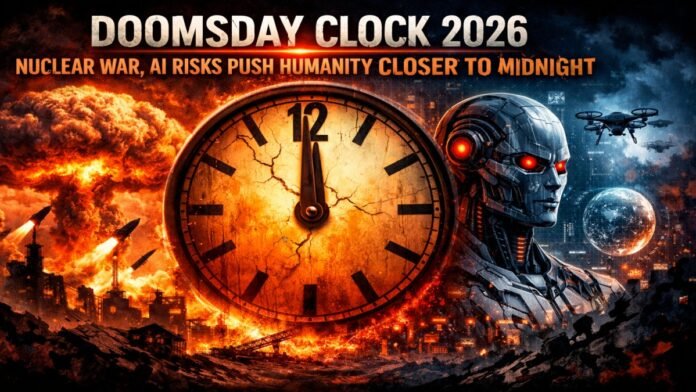
Key Points
- Doomsday Clock 2026 update to be announced today by the Bulletin of the Atomic Scientists
- Clock was set at 89 seconds to midnight last year, the closest in history
- Ongoing wars, nuclear threats, climate crisis, and AI risks driving global instability
- Experts warn that delays in corrective action increase the risk of catastrophe
Amid rising global tensions, relentless wars, rapid technological advancements, and worsening climate risks, the Doomsday Clock will be unveiled today, offering a grim assessment of how close humanity stands to self-destruction. The symbolic clock will be updated by the Bulletin of the Atomic Scientists in Washington, D.C., with the announcement expected around 8 PM Indian Standard Time.
The update comes at a time when the world is grappling with overlapping crises, from prolonged armed conflicts to the unchecked expansion of disruptive technologies, raising fears of an irreversible global catastrophe.
What Is the Doomsday Clock and What Does Midnight Mean
The Doomsday Clock is a symbolic timepiece created in 1947 by the Bulletin of the Atomic Scientists. It is designed to represent how close humanity is to a global disaster caused by man-made threats, including nuclear war, climate change, biological dangers, and emerging technologies such as artificial intelligence.
On this clock, “midnight” signifies destruction or doomsday. The closer the hands move toward midnight, the higher the perceived risk to human civilization. In 2025, the clock was set at just 89 seconds to midnight, marking the closest point to catastrophe ever recorded.
Rising Destruction Risks in 2026
Experts warn that the threat landscape in 2026 has grown even more dangerous. Concerns over the possibility of a third world war, alongside the rapid and largely unregulated development of artificial intelligence, are intensifying global anxieties.
Daniel Holz, Chair of the Bulletin’s Science and Security Board, has cautioned that advances in destructive technologies are accelerating risks rather than reducing them. He has emphasized that each movement toward midnight is not symbolic alone, but a direct warning to world leaders and societies. According to the Bulletin, failing to change course now significantly raises the probability of a global catastrophe.
Global Wars and Deepening Instability
The international situation remains volatile. The Russia Ukraine war continues with no clear end in sight, maintaining the risk of escalation between nuclear-armed powers. Tensions in the Middle East remain high, while violent conflicts and humanitarian crises persist in parts of Africa, including Sudan and Somaliland.
These conflicts, combined with political instability and economic stress, have further weakened global cooperation, a factor experts say is critical to preventing disaster.
When the World Felt Safer
There was a period when humanity stood much farther from the brink. In 1991, following the end of the Cold War, the Doomsday Clock was set at 17 minutes to midnight, the safest point in its history. This shift reflected optimism after the United States and the Soviet Union signed the Strategic Arms Reduction Treaty, significantly reducing nuclear arsenals.
However, renewed geopolitical rivalries, erosion of arms control agreements, and the rise of powerful new technologies have once again pushed the world dangerously close to midnight.
As the Doomsday Clock is updated today, scientists stress that its message is not fatalistic but urgent, a call for immediate global action before time runs out.