



































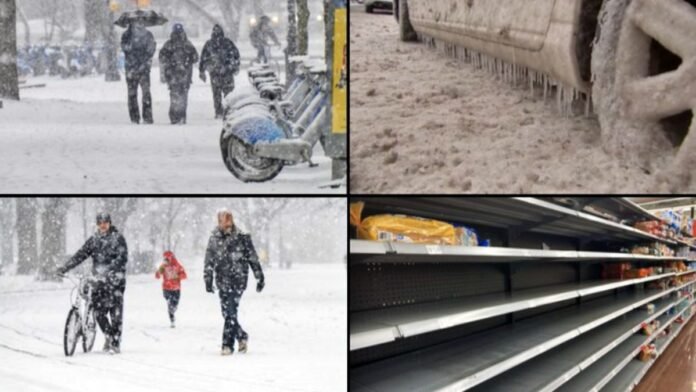
Key Points:
- Over 9,000 flights canceled across the US, with 3,300 cancellations on Saturday and 6,000 on Sunday
- State of emergency declared in 18 states as governors urge residents to stay indoors
- 140 million people affected from New Mexico to New England, with up to 30 cm of snow expected
- Temperatures dropped to -34°C in some areas, with wind chill making it feel like -24°C
- FEMA deployed 30 search and rescue teams, 7 million meals, 600,000 blankets, and 300 generators
A powerful winter storm of historic proportions has unleashed havoc across the United States, bringing life-threatening cold, heavy snowfall, and widespread disruption to transportation and daily life. The National Weather Service has warned that approximately 140 million people from New Mexico to New England could be affected by this massive weather system, which has already triggered emergency declarations in 18 states and forced the cancellation of nearly 9,000 flights.
Record-Breaking Cold and Heavy Snowfall
The storm has delivered some of the coldest temperatures seen in decades, with mercury plunging to -34°C in several areas. The National Weather Service issued warnings for particularly heavy snowfall across a vast swath of the country, from eastern Texas to North Carolina, with the storm system moving from the south toward the northeast.
On Saturday, January 24, northern Texas experienced overnight snowfall that caught many residents by surprise. The NWS reported that extremely cold winds are blowing through the region, and this situation will continue until Monday. Nighttime temperatures will mostly remain in the single digits over the next few days, and wind chill could make temperatures feel as low as -24°C, creating dangerous conditions for anyone exposed to the elements.
Major metropolitan areas face significant snow accumulation, with Washington, New York, and Boston potentially receiving up to 30 centimeters (one foot) of snow. The combination of heavy snow and fierce winds has created blizzard conditions in many areas, making travel nearly impossible and forcing authorities to close major highways and interstates.
Transportation System in Turmoil
The impact on air travel has been catastrophic. According to flight tracking service FlightAware, airlines canceled 3,300 flights on Saturday and approximately 6,000 on Sunday, bringing the two-day total to over 9,000 canceled flights. Major hubs, including Dallas-Fort Worth, Chicago O’Hare, and Boston Logan, have seen massive disruption, with ripple effects spreading across the entire national air travel network.
Road transportation has fared no better. Continuous snowfall has completely covered highways and local roads, making them impassable in many regions. State transportation departments have deployed thousands of snowplows and salt trucks, but the sheer volume and intensity of the snowfall have overwhelmed their capacity to keep pace. Governors across multiple states have issued urgent appeals for residents to stay off the roads, warning that emergency services may not be able to reach those who become stranded.
Emergency Response and Federal Assistance
The scale of the crisis has prompted governors in 18 states to declare states of emergency, unlocking federal resources and authorizing emergency measures to protect public safety. Texas Governor Greg Abbott announced that the state’s transportation department is working around the clock to clear roads, but emphasized that people should remain at home unless travel is essential.
The Federal Emergency Management Agency (FEMA) has mobilized an extensive response effort, deploying nearly 30 search and rescue teams to potential emergency hotspots across the storm-affected regions. The agency has pre-positioned more than 7 million meals, 600,000 blankets, and 300 generators in strategic locations to support affected communities and ensure continuity of critical services.
President Donald Trump said his administration is closely monitoring the situation and is fully prepared, working in coordination with state and local officials to ensure a comprehensive response. The White House has directed federal agencies to provide maximum assistance to states dealing with the storm’s impacts.
Widespread Power Outages and Public Safety Concerns
Utility companies have reported thousands of power outages across the affected regions as heavy snow and ice accumulation have brought down power lines and damaged infrastructure. The extreme cold poses a significant risk to residents without heat, particularly the elderly and vulnerable populations. Authorities have opened warming centers in many communities and are conducting wellness checks on at-risk individuals.
The National Weather Service has warned that the dangerous conditions will persist for several days, with the storm continuing to move slowly across the eastern United States. Forecasters predict that temperatures will remain well below normal through the end of the week, prolonging the recovery effort and keeping heating demands at peak levels.
Meteorologists attribute this severe weather event to a powerful Arctic air mass that has plunged southward, combining with moisture from the Gulf of Mexico to create the perfect conditions for a major winter storm. They caution that similar patterns could bring additional winter weather in the coming weeks, keeping the nation on edge as it struggles to recover from this historic storm.