

























Key Points:
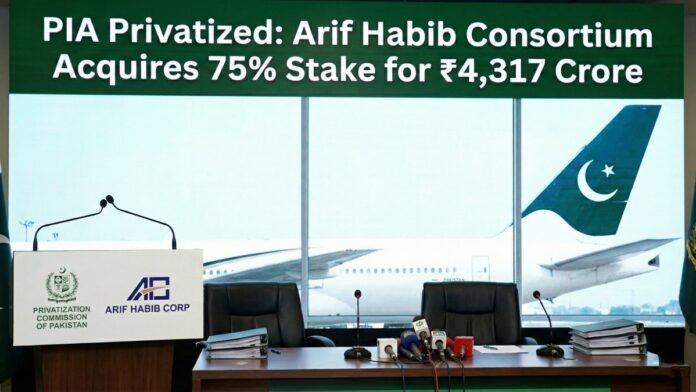
- Arif Habib Consortium wins PIA auction with highest bid of 135 billion PKR (₹4,317 crore)
- Acquires 75% stake, defeating Lucky Cement (101.5 billion PKR) and Airblue (26.5 billion PKR)
- PIA’s fleet of 32 aircraft suffered losses due to poor management and pilot license scandal
- 92.5% of sale proceeds to be used for airline’s restructuring and operations improvement
- IMF made privatization mandatory for Pakistan’s $7 billion bailout package
- Payment terms allow two-thirds upfront, remaining one-third later
- Military-linked Fauji Fertilizer withdrew last minute to avoid signaling government control
- Government permits adding two new partners post-acquisition to strengthen operations
Pakistan’s national airline, Pakistan International Airlines (PIA), has finally found a new owner after years of financial turmoil and international embarrassment. The Arif Habib Consortium has acquired a 75 per cent stake in the state-owned carrier with the highest bid of 135 billion Pakistani rupees (approximately ₹4,317 crore or $485 million), marking the largest privatisation in Pakistan’s aviation history. The consortium’s victory came after a competitive auction process that saw participation from major corporate houses, but their bids fell significantly short of the Arif Habib Group’s offer.
Companies like Lucky Cement and Airblue also participated in the auction, but their bids were lower than that of the Arif Habib Group. Lucky Cement bid 101.5 billion Pakistani rupees (approximately ₹3,246 crore), while Airblue’s bid was 26.5 billion Pakistani rupees (approximately ₹847 crore). The wide margin between the top bid and competitors reflects the Arif Habib Consortium’s aggressive strategy to gain control of Pakistan’s flagship carrier, despite its tarnished reputation and massive debt burden.
Who is Arif Habib and What Are the Payment Terms?
The Arif Habib Consortium is a group of four companies with a presence in sectors such as fertilisers, investment, energy, and education. The consortium includes Arif Habib Corporation, Fatima Fertiliser Company, Aisha Steel Mills, and University of Karachi’s investment arm, making it one of Pakistan’s most experienced and reliable corporate houses with combined assets exceeding $3 billion. The government hopes that the consortium’s involvement will improve PIA’s financial situation and services, leveraging their expertise in turnaround management.
According to Muhammad Ali, an advisor to PIA’s privatisation committee, the government’s objective is not just to sell the airline but to make it self-reliant and strong. He explained that two-thirds of the payment could be made initially and the remaining one-third later, providing financial flexibility to the consortium. Additionally, permission has been granted to add two new partners after winning the bid, allowing the consortium to bring in specialised aviation expertise or additional capital.
PIA’s Long History of Losses and Scandals
Currently, PIA’s fleet consists of 32 aircraft, including Airbus A320s, Airbus A330s, Boeing 737s, and Boeing 777s. Despite this seemingly decent fleet size, the airline had been operating at a loss for a considerable period, accumulating debts exceeding $3 billion. Poor management, flight cancellations, persistent passenger complaints, and mounting debt had weakened PIA to the point where it required monthly government subsidies of approximately $15 million just to meet payroll and operational expenses.
PIA’s reputation suffered a major blow in 2020 following a plane crash in Karachi that killed 97 people. The accident revealed that more than 260 of PIA’s pilots had questionable or fake licenses, triggering a global safety crisis. This led several countries, including the European Union, the United Kingdom, and the United States, to ban PIA flights, virtually halting the airline’s international revenue, which previously contributed 60% of its total income. The airline’s safety rating was downgraded to Category 2 by the ICAO, further restricting its operations.
IMF Pressure and Privatisation Conditions
With the increasing burden of losses, it became difficult for the Pakistani government to manage PIA. Meanwhile, pressure mounted on the government to secure a bailout package from the International Monetary Fund (IMF). The IMF made it clear that loss-making state-owned enterprises must be privatised as a condition for financial assistance. Pakistan needs a package of approximately $7 billion from the IMF, and the privatisation of PIA is considered part of that condition, along with reforms in the energy sector and tax collection.
According to the process set by the government, 92.5 per cent of the total amount received from the auction will be spent on improving, restructuring, and strengthening PIA’s operations. The remaining 7.5% will cover transaction costs and government administrative expenses. The funds will be used to pay off immediate debts, upgrade aircraft maintenance facilities, and invest in digital reservation systems to compete with regional carriers like Emirates and Qatar Airways.
Military Withdrawal and Strategic Implications
The name of Fauji Fertiliser Company, which is linked to the military, was initially included in the bidding process, but it withdrew at the last moment. According to media reports, if a military or government entity had won the bid, it would have sent the wrong message to the IMF and international investors. The IMF wants PIA to be entirely in private hands so that there is no government or military control over the airline, ensuring commercial viability and transparency.
This withdrawal marks a significant shift in Pakistan’s civil-military relations, showing that even powerful military-linked enterprises are bowing to international financial pressure. The move has been praised by business analysts who view it as a positive signal for future privatisations of other state-owned enterprises like Pakistan Steel Mills and various power distribution companies.
Future Outlook and Challenges
The Arif Habib Consortium now faces the daunting task of turning around an airline that has lost market share to foreign carriers and domestic competitor Airblue. Industry experts estimate that PIA requires at least $500 million in immediate investment for fleet modernisation, staff retraining, and route network optimisation. The consortium plans to reduce the workforce by 30% through voluntary retirement schemes, renegotiate aircraft leases, and focus on profitable Middle Eastern and European routes.
The deal is expected to close by March 2026, pending final regulatory approvals from the Competition Commission of Pakistan and aviation authorities. Success could pave the way for Pakistan’s broader privatisation agenda, while failure might deter future investors and deepen the country’s economic crisis.