



































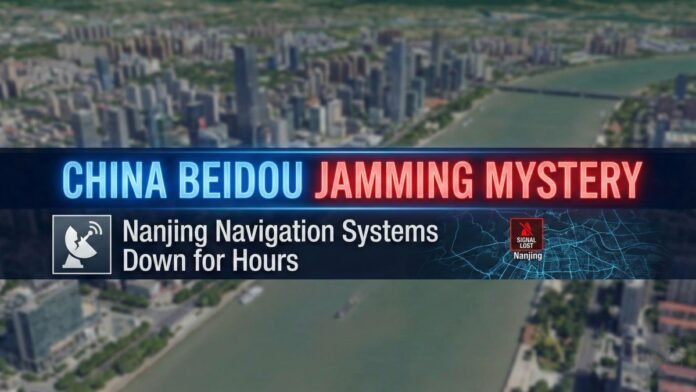
Key Points:
- GNSS signals jammed in Nanjing from 4 PM to 10 PM on December 17, 2025
- Affected car navigation, food delivery, ride-hailing, drones, and location services for millions
- Nanjing Satellite Application Industry Association confirmed intentional interference, not network malfunction
- Authorities cited security protocols for a major event, without disclosing specifics
- BeiDou is China’s 45-satellite navigation system, crucial for national security and global positioning
- Incident raises questions about GNSS vulnerability and reliance on satellite navigation for daily life
On December 17, 2025, Nanjing’s bustling streets fell into navigational chaos as GPS and BeiDou signals vanished across the ten-million-strong metropolis. The outage began precisely at 4:00 PM local time, triggering a cascade of failures in services that modern urban life depends upon. Food delivery riders for Meituan and Ele.me found themselves unable to locate customers, with approximately 15,000 active orders delayed or cancelled during the peak dinner rush. Ride-hailing services Didi and T3 suspended operations entirely, leaving commuters stranded at metro stations and shopping centers. Even pedestrians unfamiliar with the city’s layout discovered their smartphones displaying location errors of up to 15 kilometers, rendering digital maps useless.
The disruption extended beyond consumer convenience. Drone operations for construction monitoring, agricultural surveys, and emergency services ground to a halt. Nanjing’s smart traffic management system, which relies on real-time vehicle positioning data, switched to manual control, causing congestion on major arteries like Zhongshan Road and Hunan Road. By 6:30 PM, social media platforms Weibo and Douyin were flooded with complaints from frustrated citizens, with the hashtag #NanjingNavigationDown trending nationally with over 3 million views within two hours.
Technical Investigation Reveals Deliberate Jamming
The Nanjing Satellite Application Industry Association, comprising 47 member companies and research institutions, launched an immediate technical investigation. Their preliminary report, released on December 19, concluded that the outage resulted from “significant interference and jamming of GNSS signals” rather than equipment failure or network issues. The association’s technical team detected powerful radio frequency signals in the L1 and L2 bands, specifically targeting the civilian frequencies used by GPS (1575.42 MHz) and BeiDou (1561.098 MHz).
The jamming technique employed was sophisticated, using multiple interference sources to create a “denial bubble” over Nanjing’s urban core. Even devices with offline map applications failed because GNSS receivers require satellite signals to determine initial position fixes. The interference created a signal-to-noise ratio so poor that receivers couldn’t lock onto the satellite constellations. Interestingly, military-grade encrypted BeiDou signals remained unaffected, suggesting the jamming was precisely calibrated to impact only civilian users while preserving strategic capabilities.
Security Event Behind the Silence
Nanjing authorities remained tight-lipped during the outage, issuing only brief statements about “technical maintenance.” On December 20, a municipal government spokesperson provided the first official explanation, stating that “controlling signals for the security of a major event falls under normal security protocols.” The statement declined to identify the event, its nature, or the specific security threat that necessitated such drastic measures.
Sources within China’s aerospace security community suggest the jamming coincided with a high-level meeting of the Jiangsu Provincial Party Committee, possibly attended by Politburo members. Others speculate it is related to a military logistics exercise or the movement of sensitive materials through Nanjing’s strategic location on the Yangtze River. The six-hour window aligns with typical security protocols for VIP movements in China, though the scale of impact on civilian infrastructure marks an unusually broad application of such measures. After the event concluded around 10 PM, signals gradually returned, with full restoration completed by 10:47 PM.
BeiDou System: China’s Navigation Backbone
The BeiDou Navigation Satellite System represents China’s strategic answer to American GPS dominance. Its full constellation of 45 satellites, including 30 operational MEO satellites, 10 GEO satellites, and 5 IGSO satellites, provides global coverage with positioning accuracy of 2.5 meters for civilian users and centimeter-level precision for military applications. China completed BeiDou-3 in 2020 after three decades of development, investing over $10 billion in the project.
BeiDou serves more than 1.2 billion users worldwide and has been integrated into 80% of Chinese smartphones, including models from Huawei, Xiaomi, and Oppo. The system is crucial for China’s Belt and Road Initiative, providing navigation for shipping, aviation, and infrastructure projects across 140 countries. For China’s military, BeiDou enables precision-guided weapons, autonomous vehicles, and secure communications independent of foreign satellite systems. The Nanjing incident demonstrates China’s willingness to prioritize security concerns over civilian convenience, even when using its own strategically vital navigation infrastructure.
Broader Implications for Digital Dependency
The Nanjing blackout serves as a stark reminder of modern society’s vulnerability to GNSS disruption. A 2024 study by the China Academy of Information and Communications Technology estimated that a 24-hour GNSS outage in a tier-1 Chinese city would cause economic losses exceeding ¥8.7 billion ($1.2 billion). The six-hour Nanjing incident likely cost the local economy approximately ¥2.2 billion in lost productivity, delayed deliveries, and service disruptions.
International observers note that GNSS jamming, while common in conflict zones and military exercises, rarely affects major civilian populations so directly. The incident raises questions about proportionality and public communication during security operations. European Space Agency officials have expressed concern, noting that similar jamming could impact international flights transiting Chinese airspace. The US State Department’s Bureau of Oceans and International Environmental and Scientific Affairs is reportedly monitoring the situation, though no formal diplomatic protest has been filed.
Future Preparedness and Technical Countermeasures
In response to the outage, Nanjing’s technology commission announced on December 21 a review of the city’s navigation infrastructure resilience. Proposals include deploying terrestrial backup systems using eLORAN (enhanced Long Range Navigation) towers, which provide positioning independent of satellites. The commission is also evaluating multi-constellation receivers that could switch between GPS, BeiDou, GLONASS, and Galileo systems, making jamming more difficult.
For individual users, the incident highlights the importance of maintaining traditional navigation skills and offline map backups. Technology companies are accelerating development of hybrid positioning systems that combine Wi-Fi fingerprinting, cellular tower triangulation, and inertial navigation to provide location data when GNSS fails. However, these alternatives lack the precision and reliability of satellite systems for critical applications like autonomous vehicles and emergency services.