
































Key Points:
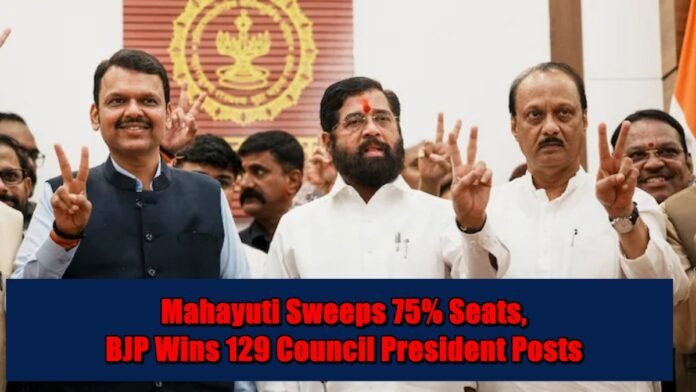
- Mahayuti alliance wins 75% of 286 Municipal Councils and Nagar Panchayats
- BJP emerges as largest party with 48% of newly elected members
- 129 BJP candidates elected as Municipal Council Presidents
- Devendra Fadnavis credits development agenda and organizational coordination
- Alliance partners NCP and Shiv Sena contribute to comprehensive victory
- Results seen as crucial indicator for upcoming state and national elections
The results of the Maharashtra Municipal Council and Nagar Panchayat elections have delivered a resounding mandate to the Mahayuti alliance, cementing its political dominance across the state’s grassroots governance structure. With the BJP securing nearly half of all elected positions and the alliance capturing three-quarters of local bodies, Chief Minister Devendra Fadnavis has interpreted the verdict as a powerful endorsement of his government’s development-centric governance model.
Decisive Victory Across 286 Local Bodies
Vote counting began at 10 AM on Sunday, with early trends immediately indicating a Mahayuti sweep across Maharashtra’s municipal landscape. The alliance, comprising the BJP, Ajit Pawar’s Nationalist Congress Party (NCP), and Eknath Shinde’s Shiv Sena, has emerged victorious in approximately 214 of the 286 Municipal Councils and Nagar Panchayats that went to polls, translating to a commanding 75% strike rate.
Chief Minister Fadnavis, addressing a packed press conference at his official residence, presented detailed figures that underscore the BJP’s individual strength within the alliance. Approximately 48% of the newly elected members across all local bodies were elected on the BJP’s lotus symbol, demonstrating the party’s deep penetration at the grassroots level. This performance establishes the BJP as not just the senior partner but the principal pole of Maharashtra politics.
BJP’s Council President Dominance
The most striking statistic from these elections is the BJP’s performance in the race for Council President positions. A total of 129 BJP candidates have won the top post in various municipal councils, giving the party direct control over local administration in nearly 45% of all local bodies. This achievement is particularly significant as Council Presidents wield considerable influence over local development projects, fund allocation, and implementation of state government schemes.
The remaining Council President positions were distributed among Mahayuti partners, with Ajit Pawar’s NCP securing approximately 45 seats and Eknath Shinde’s Shiv Sena winning around 40 posts. This distribution reflects a carefully calibrated seat-sharing arrangement that maximized the alliance’s collective strength while respecting each partner’s regional influence.
Development-Only Campaign Strategy
Chief Minister Fadnavis emphasized that the BJP and Mahayuti fought these elections entirely on the plank of development, deliberately avoiding personal attacks on political rivals. “Throughout the campaign, I never personally criticized any opposition leader or party,” Fadnavis stated. “Our entire focus remained on a positive development agenda, the public welfare work undertaken by our government, and our future plans for Maharashtra’s progress.”
This strategy marked a departure from the often acrimonious campaigns seen in previous elections. The Chief Minister highlighted specific achievements that resonated with voters, including the Ladki Bahin Yojana (monthly financial assistance to women), Mukhyamantri Majhi Ladka Bhau Yojana (support for young men), infrastructure development in rural areas, and the successful implementation of various centrally sponsored schemes.
Organizational-Government Synergy
Fadnavis attributed this comprehensive victory to precise coordination between the party organization and the government machinery. “While the government won hearts with its development plans, the organization worked tirelessly to take these plans to the grassroots level,” he explained. This synergy proved crucial in translating government schemes into electoral dividends.
The BJP’s organizational strength was evident in its booth-level management, voter outreach programs, and effective use of digital platforms to communicate achievements. The party deployed over 50,000 workers across the state during the campaign phase, ensuring that the development message reached every household.
Opposition’s Dismal Performance
The opposition Maha Vikas Aghadi (MVA), comprising Uddhav Thackeray’s Shiv Sena (UBT), Sharad Pawar’s NCP (SP), and Congress, suffered a devastating defeat. The alliance managed to win only about 60 Council President seats, with Congress securing a mere 15 posts, highlighting its continued decline in Maharashtra’s political landscape.
MVA leaders have attributed their defeat to alleged misuse of government machinery and the “money power” of the ruling alliance. However, independent observers note that the opposition failed to present a coherent alternative development agenda, instead focusing on criticizing the Mahayuti government.
Implications for Future Elections
These local body results are being viewed as a crucial semi-final before the 2029 Lok Sabha elections and the next Maharashtra Assembly elections. The BJP’s ability to win independently of its alliance partners in many areas demonstrates its expanding base, while the Mahayuti’s collective performance shows that the alliance remains electorally viable.
Political analysts suggest that this victory will embolden the BJP to push for early assembly elections, though Fadnavis has dismissed such speculation. “Our focus is on governance and development, not political calculations,” he maintained.
Urban-Rural Divide and Caste Dynamics
A closer analysis reveals that the Mahayuti performed exceptionally well in both urban and rural areas, breaking traditional patterns where regional parties dominated rural hinterlands. The BJP made significant inroads into Maratha-dominated regions, OBC strongholds, and even areas considered bastions of the opposition.
The party’s social engineering strategy, which included targeted welfare schemes for different communities, appears to have paid dividends. The Ladki Bahin Yojana, in particular, is credited with mobilizing women voters across caste and community lines in favor of the Mahayuti.
Administrative Reforms and Local Governance
With Mahayuti controlling 75% of local bodies, the state government can now expect smoother implementation of its policies at the grassroots level. Council Presidents aligned with the ruling alliance are more likely to cooperate with state government initiatives, reducing administrative friction that often plagued previous regimes.
The Election Commission reported a voter turnout of approximately 68%, indicating strong public engagement with local governance issues. This high participation rate, combined with the decisive mandate, provides the Mahayuti with a robust foundation for accelerating development projects across Maharashtra.