

































Key Points:
- Electoral trust donations jumped 200% to ₹3,811 crore in 2024-25
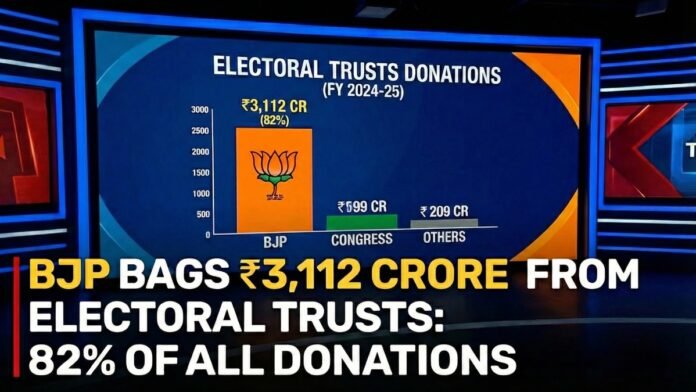
- BJP secured ₹3,112 crore, capturing 82% of all trust donations
- Congress received ₹299 crore, just 8% of the total funding
- Prudent Electoral Trust donated ₹2,180 crore to BJP alone
- Progressive Electoral Trust gave ₹758 crore to BJP from Tata Group companies
- Four trusts declared zero contributions, indicating selective corporate giving
In the first financial year following the Supreme Court’s landmark decision striking down the anonymous electoral bonds scheme, corporate donations through electoral trusts have surged dramatically, with the ruling Bharatiya Janata Party emerging as the overwhelming beneficiary. Nine electoral trusts collectively donated ₹3,811 crore to political parties in 2024-25, with the BJP receiving an unprecedented ₹3,112 crore, accounting for more than 82% of the total funds distributed through this channel.
Massive Funding Surge After Transparency Mandate
The ₹3,811 crore donated through electoral trusts represents a staggering 200% increase from the ₹1,218 crore declared in the 2023-24 financial year, according to reports submitted to the Election Commission of India and analyzed by the Indian Express. This sharp rise suggests that corporations have swiftly shifted their political funding from the now-defunct electoral bonds, which offered complete anonymity, to electoral trusts, which require partial disclosure.
Of the 19 electoral trusts currently registered with the Election Commission, reports from 13 were available as of December 20, 2025. Nine trusts declared contributions totaling ₹3,811 crore, while four trusts, Janhit, Parivartan, Jai Hind, and Jai Bharat, did not declare any contributions this year, indicating a consolidation of corporate giving among a select group of trusts.
Prudent Electoral Trust: The BJP’s Biggest Benefactor
The Prudent Electoral Trust emerged as the dominant player in political funding, contributing a massive ₹2,180.07 crore to the BJP out of its total donations of ₹2,668 crore. This single trust accounted for 70% of all BJP funding from electoral trusts.
Prudent primarily received funds from major industrial houses, including:
- Jindal Steel and Power
- Megha Engineering
- Bharti Airtel
- Aurobindo Pharma
- Torrent Pharmaceuticals
While Prudent also donated to other parties, including Congress (₹21.63 crore), Trinamool Congress, Aam Aadmi Party, and Telugu Desam Party, approximately 82% of its total funds flowed directly to the BJP, maintaining the same proportion as the overall trust funding pattern.
Progressive Electoral Trust: Tata Group’s Preferred Channel
The Progressive Electoral Trust raised ₹917 crore from various companies in 2024-25, of which ₹914.97 crore was donated to political parties. A remarkable 80.82% of this amount, ₹757.62 crore, went to the BJP.
Tata Group companies, including Tata Sons, TCS, Tata Steel, Tata Motors, and Tata Power, were the main contributors to this trust. The Progressive Electoral Trust also donated ₹77.34 crore to Congress, making it one of the few trusts to provide substantial funding to the main opposition party.
Other Trusts and Their Political Preferences
The New Democratic Electoral Trust received a total of ₹160 crore from Mahindra Group companies, of which ₹150 crore was given to the BJP, demonstrating the auto major’s clear preference for the ruling party.
The Harmony Electoral Trust received ₹35.65 crore, primarily from Bharat Forge (₹22 crore) and Kalyani Steel, and donated ₹30.15 crore to the BJP, with nothing going to Congress.
The Triumph Electoral Trust channeled ₹21 crore of its ₹25 crore corpus to the BJP, with CG Power being the largest contributor.
The Janakalyan Electoral Trust, which received only ₹19 lakh, split its donations equally between the BJP and Congress, giving ₹9.50 lakh to each party.
Shiv Sena UBT’s Unique Funding Source
In an interesting development, Mumbai-based KEC International Limited was the only company that donated to the Janpragati Electoral Trust. Of the total ₹1.02 crore received by the trust, ₹1 crore was donated to Shiv Sena (UBT), the faction led by Uddhav Thackeray, while the remaining ₹2 lakh went to the BJP. This makes Janpragati the only trust where a regional party received the lion’s share of donations.
Congress’s Diminished Share
The Congress party’s receipt of ₹299 crore, approximately 8% of total electoral trust donations, highlights its weakened position in attracting corporate funding. In addition to the ₹77.34 crore from Progressive Electoral Trust and ₹21.63 crore from Prudent, Congress received ₹5 crore from New Democratic Electoral Trust and ₹9.50 lakh from Janakalyan Electoral Trust.
This funding disparity occurs as Congress prepares for upcoming state elections and the 2029 general elections, raising questions about its ability to match the BJP’s financial resources in campaign spending.
Transparency vs. Anonymity: The New Funding Landscape
The Supreme Court’s February 2024 judgment declared the electoral bonds scheme unconstitutional, citing violations of the right to information. The court mandated that political funding must be transparent, leading companies to shift to electoral trusts and direct donations through checks, demand drafts, or UPI transfers, all of which must be disclosed to the Election Commission.
In the last financial year (2023-24), the BJP received a total of ₹3,967.14 crore in voluntary contributions, of which 43% came through electoral bonds. The current surge in electoral trust donations suggests that corporations have adapted quickly to the new transparency requirements while maintaining their political funding patterns.
Implications for Democratic Funding
The concentration of over 80% of electoral trust funding with a single party raises concerns about corporate influence and political competition. Critics argue that such massive funding disparities could undermine fair electoral competition, while supporters of the current system emphasize that transparency allows voters to see which companies support which parties.
The Election Commission has not yet commented on the funding distribution, but opposition parties are likely to raise this issue in Parliament, demanding a level playing field in political funding.