
































Key Points:
- Trump claims peace deal “closer than ever” after Zelenskyy’s Berlin talks
- Zaporizhzhia nuclear plant agreement appears near between Russia and Ukraine
- European leaders agree to provide Western security guarantees to Ukraine
- Zelenskyy indicates willingness to abandon NATO aspirations for security assurances
- Trump cites “strong support” from Germany, France, and UK in peace efforts
- Territorial control disagreements remain biggest obstacle to final agreement
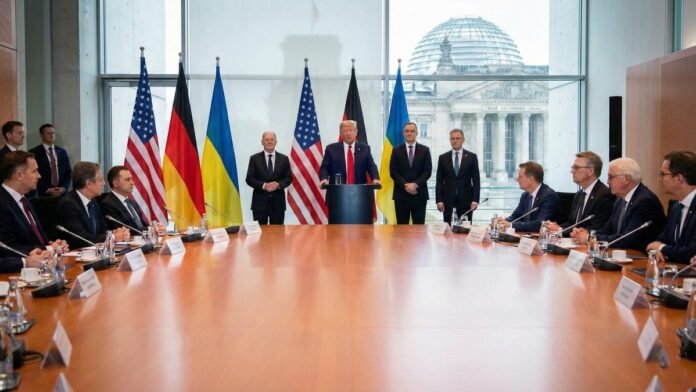
US President Donald Trump made a significant announcement at the White House, stating that a peace agreement to end the four-year war between Ukraine and Russia is now “closer than ever”. This optimistic claim follows Ukrainian President Zelenskyy’s extensive discussions with European and NATO leaders in Berlin, where critical issues were addressed. Trump emphasized that the United States is receiving “very strong support” from key European nations including Germany, France, and the United Kingdom in pursuing a diplomatic resolution.
The President expressed confidence based on his recent conversations with Russian President Vladimir Putin, stating, “We’re going to get it done. We want to save a lot of lives”. However, Trump acknowledged the complexity of the situation, noting that getting Russia and Ukraine “on the same page” represents the most significant challenge, as both sides have shown inconsistent readiness for negotiations.
Breakthrough on Nuclear Plant and Security Guarantees
A major development emerged from the Berlin talks regarding the Zaporizhzhia nuclear power plant, Europe’s largest nuclear facility currently under Russian control. According to the White House, Russia and Ukraine appear to be nearing an agreement on the plant’s future operation, which is considered crucial for broader peace negotiations. Restoring safe operation of the facility has become a priority issue that could pave the way for additional compromises.
Another significant breakthrough involves Western security guarantees for Ukraine. European leaders have agreed in principle to provide security assurances, though disagreements over territorial control continue to pose the biggest obstacle. In a major concession, President Zelenskyy has indicated that Ukraine might be willing to abandon its NATO membership aspirations if it receives concrete security guarantees from Western partners. This stance represents a significant shift and potential compromise toward reaching a peace agreement.
Ongoing Challenges and Diplomatic Efforts
Despite the positive developments, substantial hurdles remain in the path to peace. Territorial disputes, particularly regarding Crimea and eastern Ukrainian regions, continue to be the most contentious issues. Trump’s diplomatic team is working to bridge the gap between Moscow and Kyiv, with the President noting that Russia is sometimes ready for talks and sometimes not, and the same is true for Ukraine.
The diplomatic push comes as both sides face mounting pressure to end the conflict that has claimed thousands of lives and displaced millions. Western leaders are coordinating closely to present a unified approach, while simultaneously addressing Ukraine’s security concerns and Russia’s strategic interests. The coming weeks will be critical in determining whether these diplomatic efforts can translate into a concrete peace agreement.