

































Key points
- Pilots’ body FIP says new FDTL rules are not the primary reason for IndiGo’s crisis, the problem is IndiGo’s lean staffing strategy.
- Over 150–200 IndiGo flights have been cancelled nationwide in recent days, causing chaos at Delhi, Mumbai, Bengaluru, Hyderabad and other airports.
- DGCA has called IndiGo’s senior management to explain the disruptions and submit a corrective plan during the busy winter and holiday season.
- FIP alleges IndiGo stopped fresh pilot hiring, slowed upgrades, reduced leave and tried to “buy” leave after new FDTL norms, further damaging morale.
- Pilots’ body suspects IndiGo is using large‑scale cancellations to pressure the government and DGCA to dilute or roll back stricter FDTL rules.
- FIP has urged DGCA to clear seasonal schedules only if airlines prove they have enough pilots under new norms, and to reallocate slots of non‑compliant airlines to carriers like Air India and Akasa.
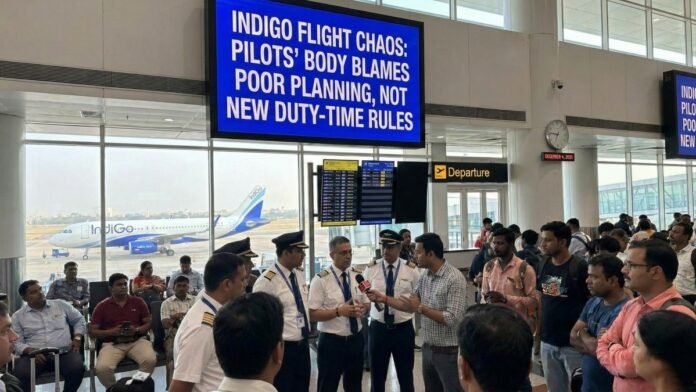
The Federation of Indian Pilots has categorically stated that the Delhi High Court–linked FDTL regulations are not the real reason hundreds of IndiGo flights have been cancelled over the last few days, instead calling the disruption a result of IndiGo’s own long‑term policies. According to FIP, other Indian airlines anticipated the higher crew requirement under the new rules and recruited additional pilots in advance, which is why they are operating largely normally while IndiGo alone is facing severe disruption.
FIP alleges that IndiGo followed a “lean manpower” strategy for years, keeping pilot numbers very tight relative to its rapidly growing schedule, even though the industry knew for a long time that stricter duty‑time and rest norms were coming. The body claims IndiGo had ample advance notice about the new FDTL regime but still slowed or halted recruitment, resisted pilots moving from other airlines, and did not revise pay or rosters in a way that would attract and retain enough crew.
New FDTL rules and how they tightened pilot availability
The latest FDTL framework, brought in following Delhi High Court directions, increases pilots’ weekly rest to 48 hours, extends the definition of night operations and caps night landings more strictly, changing how many hours and sectors a pilot can legally fly in a given period. Airlines, including IndiGo, had earlier warned DGCA that full implementation would require roughly 20–25 percent more pilots, but the regulator still went ahead with phased enforcement after a long delay.
For IndiGo, the first phase of the new regime took effect from July 1, 2025, followed by a second phase from November 1, 2025, both reducing the number of duty hours that could be squeezed out of each pilot each month. FIP and other pilots’ groups argue these changes are critical for flight safety and fatigue management, while airlines say the norms have come at a time of strong post‑pandemic demand, tight training pipelines and aircraft induction pressures.
How the IndiGo crisis escalated, cancellations across major airports
In the last few days, IndiGo’s network has seen widespread disruption, with different airports reporting large‑scale cancellations and long delays. At Delhi airport alone, dozens of IndiGo flights were cancelled in a day, while Mumbai, Bengaluru and Hyderabad also reported major disruption as aircraft remained on the ground for lack of legally available crew. Various reports estimate that over 150–200 IndiGo flights have been cancelled nationwide within a short span, with on‑time performance falling sharply.
The Directorate General of Civil Aviation has taken note and called IndiGo’s senior management to New Delhi, asking the airline to explain the unprecedented disruption during peak winter and holiday travel and to present a concrete recovery plan. IndiGo has announced “calibrated adjustments” to its schedule for at least 48 hours, which effectively means planned reductions and rescheduling of flights to match limited pilot availability, while citing a mix of crew constraints, tech glitches, winter weather, congestion and new rostering rules as contributing factors.
FIP’s charges, leave cuts, morale issues and winter fog operations
According to the pilots’ federation, IndiGo’s internal handling of the transition intensified the crisis rather than easing it. After the new FDTL phases kicked in, the airline allegedly cut pilots’ leave entitlements and then tried to “buy back” leave days to stretch existing crew, a move that reportedly received poor response and further hit morale. At the same time, senior executives are said to have received generous pay increases, a contrast that FIP claims has angered cockpit and cabin crew already stressed by tight rosters.
FIP also points out that winter is a fog‑prone season in North India, when dense fog routinely causes late departures and arrivals, which in turn demands more standby crew and buffer in pilot planning. Despite this, the federation alleges, IndiGo expanded its winter schedule, but did not proportionately recruit or train additional pilots to run those flights within the new legal duty‑time limits, creating a fragile network that collapsed once delays and congestion set in. The body goes further to suggest that the scale of cancellations looks like an attempt to build pressure on the government and DGCA by portraying the new FDTL rules as unworkable, even though other airlines have managed under the same framework.
FIP’s recommendations to DGCA to protect passengers
In its statement, the Federation of Indian Pilots has urged the aviation regulator to change how seasonal schedules are approved, arguing that DGCA should clear winter, summer or monsoon schedules only after the airline proves in writing that it has enough pilots to operate every flight in full compliance with the revised FDTL norms. This would force carriers to align network growth with actual trained crew strength, rather than relying on aggressive rostering or emergency waivers once disruptions begin.
FIP has also asked DGCA to consider withdrawing valuable take‑off and landing slots from airlines that repeatedly inconvenience passengers due to avoidable pilot shortages, and to reallocate those slots to carriers such as Air India, Akasa Air and others that can demonstrate adequate staffing. According to the body, such action would both reduce passenger suffering in peak travel periods and send a clear signal that commercial expansion cannot come at the cost of safety, crew welfare or basic schedule reliability.