


































Key Points:
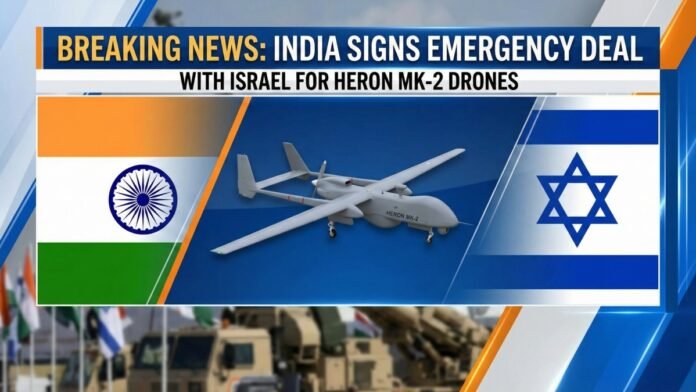
- Emergency Procurement: India signed an urgent agreement with Israel Aerospace Industries (IAI) for additional Heron MK-2 satellite-linked drones following successful deployment in Operation Sindoor.
- Multi-Service Induction: Heron MK-2 drones already serve the Indian Army and Air Force and will now be inducted into the Navy for enhanced maritime surveillance.
- Make in India Focus: September 2025 RFP issued for 87 MALE drones with mandatory domestic manufacturing, targeting 60%+ Indian-sourced components and technology transfer.
- Refueling Aircraft Deal: IAI remains sole bidder for ₹8,000 crore contract to convert six Boeing-767 aircraft into mid-air refueling tankers, meeting 30% Make in India requirement.
- Drone Capabilities: Heron MK-2 achieves 35,000-foot altitude, 45-hour continuous flight endurance, and operates with 20 military forces globally.
Following the proven operational success of Heron MK-2 drones during Operation Sindoor in May 2025, India has expedited an emergency procurement agreement with Israel Aerospace Industries (IAI) for an additional batch of these advanced surveillance systems. An IAI defense industry official confirmed that the Heron MK-2 platform, already operational with the Indian Army and Air Force, will undergo rapid induction into the Indian Navy as well, expanding the drone’s deployment across all three military services. The official emphasized the strategic partnership, stating, “India is a key customer for us. Our partnership spans three decades and generations,” underscoring the deep institutional ties between New Delhi and Tel Aviv in defense procurement.
Make in India Targets 87 MALE Drones with 60% Domestic Content
Building on this momentum, India’s Ministry of Defense issued a Request for Proposal (RFP) in September 2025 for the acquisition of 87 Medium Altitude Long Endurance (MALE) drones, with stringent domestic manufacturing requirements embedded in the tender framework. IAI has committed to manufacturing these advanced systems within India, aiming to develop an indigenized “Indian version of the Heron” tailored to national operational requirements. Critically, the procurement parameters mandate that manufacturers source more than 60% of components from Indian suppliers and facilitate significant technology transfer to domestic defense industries. This ambitious localization strategy aligns with the Indian government’s broader Make in India initiative, designed to reduce import dependency and build indigenous defense manufacturing capacity.
Heron MK-2 Specifications and Global Deployment
The Heron MK-2 represents a cutting-edge surveillance platform capable of sustained high-altitude reconnaissance missions. The system can achieve altitudes of 35,000 feet and maintain continuous flight operations for up to 45 hours without refueling. This exceptional endurance and altitude capability make it ideal for extended border surveillance, maritime patrol, and intelligence gathering operations. Beyond India’s procurement, the Heron MK-2 operates with approximately 20 military forces globally, demonstrating its proven reliability and operational effectiveness in diverse operational theaters.
IAI Sole Survivor in ₹8,000 Crore Refueling Aircraft Tender
In parallel defense developments, Israel Aerospace Industries has emerged as the sole remaining bidder for India’s ₹8,000 crore (approximately $960 million USD) tender for six mid-air refueling aircraft under the Make in India program. The tender mandates that participating vendors use approximately 30% Made in India materials in their aircraft design and manufacture. Russian and European competitors were eliminated from consideration after failing to meet these indigenous content thresholds. IAI Executive Vice President Yehuda Lahav declined to specify manufacturing locations should IAI win the contract, maintaining operational confidentiality on production strategy.
Boeing 767 Tanker Conversion Strategy
According to defense sources, if IAI secures the contract, the company intends to acquire and modify six used or second-hand Boeing-767 commercial aircraft into tanker configurations optimized for Indian Air Force requirements. The Indian Air Force currently operates only two Russian-origin mid-air refueling aircraft, which provide critical aerial logistics support for fighter operations and also support naval aviation requirements. Despite repeated acquisition attempts over the past 15 years, the Air Force has been unable to expand this limited tanker fleet due to budgetary constraints, technical requirements, and vendor qualifications. The proposed IAI contract would quadruple India’s mid-air refueling capacity, substantially enhancing aerial combat endurance and operational flexibility across the force structure.