



































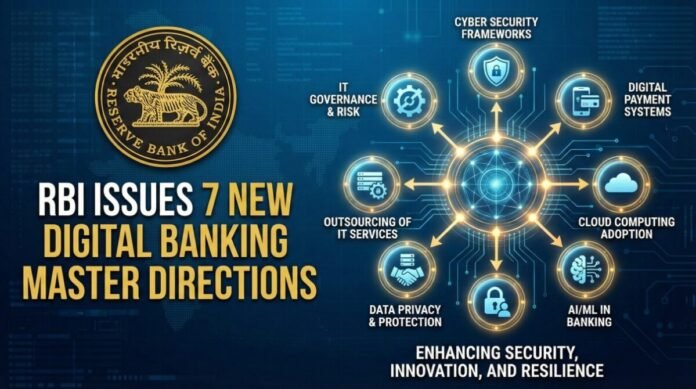
Key Points
- RBI replaces 9,445 old circulars with 244 Master Directions, eliminating regulatory complexity
- Seven new Master Directions specifically for digital banking channels, effective January 1, 2026
- Applies to commercial banks, small finance banks, payment banks, local area banks, regional rural banks, and cooperative banks
- Oldest repealed circular dated back to 1944, covering loans against British government bonds
- New rules mandate explicit customer consent for digital banking and automatic transaction alerts
- Stricter cybersecurity requirements and technological controls for all digital banking operations
- Small banks now empowered to offer digital services equivalent to larger banks
The Reserve Bank of India has undertaken a historic regulatory modernisation, consolidating over two decades of fragmented circulars and guidance documents into a coherent framework of 244 Master Directions. This monumental consolidation exercise, completed over approximately six months, represents one of the most significant RBI reforms aimed at simplifying banking regulations for both financial institutions and customers. The initiative directly addresses the persistent problem of regulatory confusion arising from overlapping and sometimes contradictory guidance spread across thousands of separate documents.
The digitisation revolution in banking had created a patchwork of ad-hoc regulations issued through individual circulars as new technologies emerged, leading to compliance nightmares for banks. By consolidating digital banking rules into seven new Master Directions, the RBI has created a single, comprehensive source of guidance for all regulated entities. This “One Nation, One Rule” approach aligns with the Reserve Bank’s stated objective of making banking easier and more uniform across the country, regardless of bank size or type.
Digital Banking Master Directions: What Changed
The seven new Master Directions on Digital Banking Channels Authorisation establish uniform rules for internet banking, mobile banking, UPI, and other digital channels across all bank categories. Each Master Direction is tailored to specific bank types, commercial banks, small finance banks, payment banks, local area banks, regional rural banks, urban cooperative banks, and rural cooperative banks, ensuring that regulations remain proportionate to institutional scale and capacity.
Critically, the new framework requires explicit customer consent before enrolling in digital banking services, eliminating the previous practice of automatic enrollment. Banks must now obtain documented permission from customers before provisioning any digital banking channel. Additionally, banks are mandated to provide automatic transaction alerts for all digital transactions, ensuring customers receive real-time notifications of account activity. The directions also prohibit banks from making digital banking mandatory for accessing other services like debit cards, preserving customer choice.
Enhanced Cybersecurity: Mandatory Compliance Framework
The seven new Master Directions significantly tighten technological and cybersecurity requirements across all digital banking operations. Banks offering digital services must now comply with specific technology standards prescribed by the RBI and conduct comprehensive Gap Assessment and Internal Controls Adequacy (GAICA) reports certified by CERT-In empanelled auditors. For the first time, a satisfactory cybersecurity track record is a prerequisite for authorisation, assessed through the absence of major adverse observations in Information Security audit reports for the preceding two financial years.
These enhanced requirements effectively eliminate the possibility of banks launching digital services with weak security infrastructure. Core Banking Solution implementation and Infrastructure Protocol Version 6 (IPv6) traffic handling capability become non-negotiable prerequisites. The directions specify transaction limits, velocity limits, fraud detection mechanisms, and other risk mitigation measures that each bank must implement according to its risk appetite. This systematic approach converts digital banking from a competitive race to the bottom into a security-first ecosystem.
Uniform Rules Enable Small Bank Parity
Previously, smaller institutions like regional rural banks and small finance banks operated under different digital banking guidelines, creating operational inefficiencies and limiting their competitive ability to offer sophisticated digital products. The new Master Directions establish identical digital banking rules for all bank categories, enabling small finance banks and local area banks to offer services equivalent to large commercial banks. This regulatory parity effectively levels the playing field for smaller institutions.
The unified framework accelerates digital service deployment by eliminating the need for banks to navigate multiple sets of rules. Previously, a digital service innovation might require different authorisation processes at different banks. Now, a single Master Direction applies uniformly. This standardisation reduces compliance costs and allows smaller banks with limited regulatory resources to implement sophisticated digital solutions previously available only to large institutions.
Implementation Timeline and Bank Obligations
All seven new Master Directions on digital banking take effect on January 1, 2026, providing banks with approximately one month to prepare systems and implement required changes. Every bank must develop a comprehensive digital banking policy covering internet banking, mobile banking, UPI, and other digital channels. These policies must address customer fund protection mechanisms, liquidity management protocols, technical glitch response procedures, and comprehensive cyber risk management.
Banks beginning view-only digital banking after the effective date must notify the Reserve Bank’s concerned regional office with supporting documentation confirming compliance with the eligibility criteria. Banks already operating digital channels before January 1, 2026, must undergo alignment to ensure compliance with new requirements. The Reserve Bank has indicated that compliance verification will begin immediately after the January 1, 2026, effective date, with supervisory examinations evaluating each bank’s digital banking policies and technological controls.
Customer Benefits: Faster Processing and Enhanced Fraud Protection
The simplified and standardised regulatory framework will enable banks to process customer complaints and service requests significantly faster. Previously, banks needed to navigate multiple circulars to determine appropriate response timelines for different transactions, creating variability in service quality. Uniform Master Directions establish clear, consistent procedures across all banks. Customers will experience standardized protections, clearer terms and conditions, and faster resolution of digital banking issues, regardless of which bank they use.
The mandatory transaction alerts and explicit consent requirements provide customers with unprecedented visibility and control over their digital banking activities. Tighter cybersecurity standards reduce fraud risk significantly, as all banks must now meet identical security benchmarks. The elimination of complex regulatory fragmentation means banks can focus resources on customer experience rather than regulatory interpretation, ultimately delivering faster, more secure digital banking to Indian customers.