






























Key points
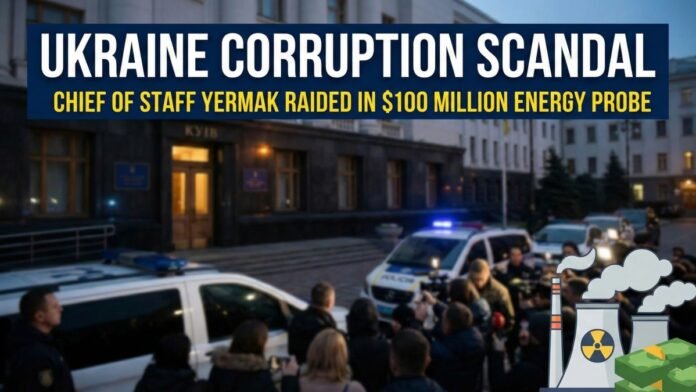
- Ukrainian anti-corruption authorities searched the residence and office of Andriy Yermak, Zelenskyy’s chief of staff and key negotiator in peace talks, as part of an investigation into a $100 million energy sector corruption scheme involving officials and oligarchs.
- The scandal implicates several high-ranking officials and businesspeople, with investigators believing Tymur Mindich, a former Zelenskyy business associate who has fled Ukraine, was the scheme’s architect, and two government ministers have already resigned.
- Yermak denied wrongdoing and stated he is cooperating fully with investigators, but Zelenskyy’s own lawmakers have demanded his removal or threatened a party split that could cost the president his parliamentary majority.
- The Trump administration has proposed a 28-point peace framework requiring Ukraine to renounce NATO membership, limit military personnel to 600,000, and accept de facto Russian control of Crimea, Luhansk, Donetsk, and Zaporizhzhia regions.
- Russian forces have launched seven major combined strikes in the past two months targeting energy infrastructure, with the November 25 attack involving 464 long-range drones and 22 missiles, killing at least eight civilians and injuring 34, including children.
- Civilian deaths from Russian long-range weapons have surged 26 percent in 2025 compared to January-October 2024, to 548 fatalities, while injuries jumped 75 percent to 3,592, with Kyiv alone seeing nearly four times more civilian casualties in the first ten months of 2025 than in all of 2024.
Anti-corruption investigators descended on Andriy Yermak’s residence early Friday morning as part of a sweeping probe into a $100 million kickback scheme centered in Ukraine’s state energy enterprise, Energoatom, marking the first public search of Zelenskyy’s inner circle in the scandal that has rocked the wartime government. According to official statements, the National Anti-Corruption Bureau of Ukraine and the Specialized Anti-Corruption Prosecutor’s Office, both Western-supported watchdog agencies, are investigating allegations that current and former officials, as well as prominent business figures, received benefits, laundered money, and orchestrated fraudulent deals within the energy sector infrastructure.
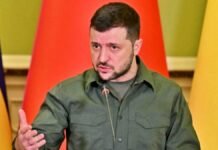
Yermak, who has wielded enormous influence as Zelenskyy’s chief of staff throughout the war and has been instrumental in ongoing peace negotiations with the United States, has not been formally accused of any crime, but the raid signals that investigators are scrutinizing his office and decision-making authority in connection with the energy sector schemes. In a statement posted on Telegram, Yermak declared that investigators face no obstacles and that he is cooperating fully with all authorities, with his legal team present during the search, an assurance many analysts view as a strategic move to manage the public and political fallout.
Political turmoil and internal revolt
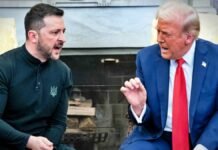
The corruption probe has triggered an unprecedented domestic political crisis for Zelenskyy, as members of his own parliamentary party have openly demanded that Yermak resign or face consequences, warning that if the president does not act, the party could fracture and cost Zelenskyy his legislative majority at a time when wartime unity and parliamentary stability are essential. The scandal, which burst into public view in early November when anti-corruption agencies disclosed the $100 million probe, has shattered the domestic consensus that had largely held in Ukraine since the 2022 Russian invasion, with critics arguing that corruption during wartime undermines military morale, international support, and the moral legitimacy of Ukraine’s cause.
The scheme allegedly involved Tymur Mindich, a businessman with prior ties to Zelenskyy before the war, who is believed to have orchestrated the corruption network and has since fled Ukraine, with criminal proceedings against him likely to be conducted in absentia if charges are filed. Two current government ministers have already stepped down due to the scandal, and a third deputy under Yermak’s direct supervision, Andriy Smyrnov, remains under investigation for bribery and financial misconduct but continues in his post, creating additional political friction. The European Union, which Ukraine is seeking to join as part of its post-war development strategy, has made clear to Zelenskyy that anti-corruption reform and elite accountability are non-negotiable conditions for membership and continued financial assistance.
Trump’s 28-point peace proposal
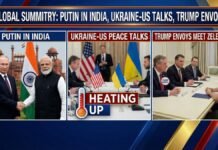
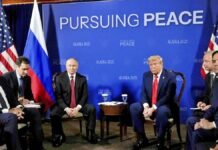
Amid the domestic corruption turmoil, the Trump administration has presented a comprehensive 28-point peace framework to both Russian and Ukrainian officials, a document that would require Ukraine to make sweeping territorial and military concessions and fundamentally reshape the geopolitical order in Eastern Europe. Under the proposal, Ukraine would be forced to recognize Russian de facto control over Crimea, which has been under Russian military occupation since 2014, as well as the Luhansk and Donetsk regions in eastern Donbas that Russia has held since 2022, and would maintain Russian control along the current contact line, effectively formalizing the loss of roughly 19 percent of Ukrainian territory.
In exchange for these territorial sacrifices, Ukraine would receive vague security guarantees but would be permanently barred from joining NATO, a cornerstone of Kyiv’s long-term security strategy, and the plan also stipulates that Ukraine must reduce its armed forces to a maximum of 600,000 personnel, renounce nuclear weapons development, and agree to hold elections within 100 days to restore civilian governance. The framework would establish a Peace Council to oversee implementation and be chaired by President Donald Trump, alongside provisions for a Russia-NATO security dialogue and a joint U.S.-Russia working group to monitor compliance, essentially placing the Trump administration and Washington in a supervisory role over Ukraine’s future. The plan also includes measures to lift international sanctions on Russia and facilitate its reintegration into the global economy, to extend existing U.S.-Russia arms control treaties, and to grant amnesty to all parties involved in the conflict for wartime actions, preventing future accountability or reparations claims.
Escalating Russian military pressure
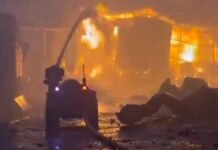
Compounding Zelenskyy’s political and diplomatic challenges, Russian forces have dramatically intensified their assault on Ukrainian infrastructure and population centers, launching seven major combined strikes in just two months, predominantly targeting energy generation and distribution systems across multiple regions. The most recent massive assault, conducted in the night of November 24-25, saw Russian forces deploy 464 long-range drones and 22 ballistic missiles simultaneously against multiple targets, resulting in at least eight civilian deaths, 34 injuries, including four children, widespread destruction of residential buildings and critical infrastructure, and temporary disruptions to electricity, water and heating services in affected areas.
The escalation in Russian long-range weapon usage has been particularly devastating to Ukraine’s civilian population, with 548 civilians killed by missiles and drones through October 2025, representing a 26 percent increase over the comparable 2024 period, and 3,592 civilians injured, a 75 percent surge compared to the same 2024 timeframe. Kyiv, Ukraine’s capital and largest city, has experienced the most severe civilian casualty spike, with the first ten months of 2025 recording nearly four times more civilian deaths than during the entire year of 2024, while other major urban centers such as Dnipro and Zaporizhzhia have similarly witnessed dramatic increases in civilian casualties from sustained Russian strikes. The systematic destruction of energy facilities has compounded civilian suffering during the onset of winter, as heating, electricity and water systems fail, and reconstruction experts warn that rebuilding efforts could take years, adding a psychological toll to the physical devastation.