































Key Points:
- 2% DA hike expected from January 2026, lowest in seven years
- DA to increase from 58% to 60%, similar to January 2025 increase
- First DA hike outside 7th Pay Commission’s 10-year cycle
- 7th CPC ends December 31, 2025, 8th Pay Commission still in process
- 8th Pay Commission report may take 18 months, implementation could take two more years
- New pay structure likely by late 2027 or early 2028
- AICPI-IW index rose from 146.5 to 147.7 between July-October 2025
- Employee with ₹50,000 basic pay will get only ₹1,000 monthly increase
- Four upcoming DA hikes will be incorporated into new basic pay under 8th CPC
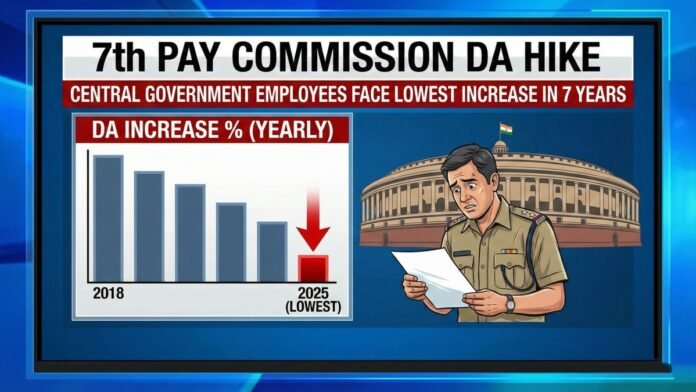
Central government employees and pensioners are bracing for a disappointing start to 2026, as they are unlikely to receive a significant salary increase in the new year. According to a report in the Financial Express, a mere 2 per cent increase in dearness allowance (DA) and dearness relief (DR) is expected from January 2026. This minimal hike will increase the current DA from 58% to nearly 60%, marking the lowest DA increase in the last seven years, similar to the mere 2% increase received in January 2025. Amidst rising inflation, employees are expressing disappointment over the small DA hike, which offers limited relief to their financial burdens.
The continuous trend of minimal DA increases reflects the complex economic environment where inflation persists but remains controlled enough to prevent substantial allowance hikes. For central government employees who have faced increasing living costs, this modest increase represents another year of constrained purchasing power. The employee unions have been vocal about their dissatisfaction, arguing that the current DA calculation methodology doesn’t accurately reflect the real inflation experienced by government servants.
Historic Transition Outside 7th Pay Commission Cycle
This year’s DA hike carries special significance as it will be the first increase implemented outside the 10-year cycle of the 7th Pay Commission. The term of the 7th CPC ends on December 31, 2025, creating a unique situation where DA hikes will continue under the old pay structure while the new commission’s recommendations remain pending. Meanwhile, the 8th Pay Commission is still in process, and its Terms of Reference do not specify the date on which the new salary structure will be implemented.
The Commission will take 18 months to submit its report, and the subsequent approval and implementation process typically takes another two years. Consequently, the new pay structure may be implemented by employees at a later date, possibly in late 2027 or early 2028. This extended timeline means that employees will continue to receive DA hikes on their existing basic pay for at least two more years before seeing the comprehensive salary restructuring that the 8th Pay Commission promises.
Dearness Allowance Calculation Methodology
Dearness allowance is calculated based on the All-India Consumer Price Index for Industrial Workers (AICPI-IW). From July to October 2025, the index increased steadily, rising from 146.5 to 147.7. This trend indicates that inflation is persisting, but the increase is not rapid enough to cause a significant increase in DA. Even after adding November and December figures, the DA for January 2026 is estimated to remain around 60%. This means inflation is rising, but employees will receive limited relief.
The calculation methodology involves averaging the AICPI-IW numbers for the past 12 months and comparing them with the base year index. The modest increase from 146.5 to 147.7 over four months suggests that while prices continue to rise, the rate of inflation has moderated compared to previous periods. This controlled inflation, while beneficial for the broader economy, translates into smaller DA hikes for government employees. The four-point increase in index values is insufficient to trigger a higher DA percentage, leaving employees with a minimal adjustment.
Direct Impact on Employees’ Pockets
A low DA hike has a direct and limited impact on employees’ pockets. For example, if someone’s basic pay is ₹50,000, they receive ₹29,000 at 58% DA. At 60% DA, this would become ₹30,000. This means a monthly increase of only ₹1,000. For employees in higher pay brackets, the absolute increase will be larger, but the percentage impact remains modest. This minimal raise fails to compensate for the rising costs of essential goods, housing, education, and healthcare that employees face daily.
The disappointment is particularly acute among pensioners who rely on dearness relief as their primary protection against inflation. With fixed incomes and increasing medical expenses, the 2% DR increase provides insufficient cushioning against price rises. Younger employees with families also feel the pinch, as school fees, transportation costs, and household expenses continue to outpace their salary growth. The gap between official inflation figures and real-world cost increases has become a persistent source of frustration.
Crucial Upcoming DA Hikes
The four upcoming DA hikes, January 2026, July 2026, January 2027, and July 2027, will be crucial, as these will be incorporated into the new basic pay when the 8th Pay Commission is implemented. Therefore, while the January 2026 DA hike is small, its impact on the future salary structure will be significant. Each percentage point increase during this interim period will be multiplied when the new pay scales are calculated, making these seemingly modest hikes more valuable in the long run.
Employees’ unions are closely monitoring these upcoming revisions, as they will form the foundation for the new pay structure. The cumulative effect of four DA hikes could add 8-10 percentage points to the current 60% DA, substantially increasing the basic pay on which the 8th Pay Commission’s multiplication factors will apply. This long-term perspective offers some consolation to disappointed employees, though immediate financial relief remains minimal.
Central government employees face a challenging two-year period of modest DA increases before the 8th Pay Commission brings comprehensive salary restructuring. While the 2% hike from January 2026 disappoints in the short term, its incorporation into future pay scales offers some long-term compensation. Employees must navigate rising inflation with limited salary growth while awaiting the more substantial reforms promised by the 8th Pay Commission. The government’s approach reflects fiscal prudence but tests the patience of millions of government servants who keep the nation’s administration running.