































Key Highlights
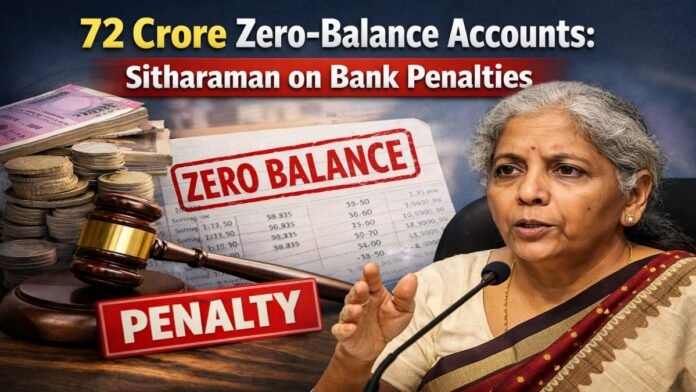
- Financial Inclusion: Approximately 72 crore Basic Savings Bank Deposit Accounts (BSBDA), including Jan Dhan accounts, require no minimum balance.
- Penalty Data: Public sector banks collected ₹8,092.83 crore in minimum balance penalties between FY 2022,23 and 2024,25.
- Revenue Context: Penalties account for a mere 0.23% of total income for public sector banks, according to the Finance Ministry.
- Fee Abolition: SBI and nine other public sector banks have completely eliminated minimum average balance (MAB) charges as of 2025.
Union Finance Minister Nirmala Sitharaman, while addressing the Lok Sabha on Monday, March 9, 2026, underscored the massive scale of India’s financial inclusion drive. Currently, there are approximately 72 crore Basic Savings Bank Deposit Accounts (BSBDA) across the country. These accounts, which encompass those opened under the Pradhan Mantri Jan Dhan Yojana (PMJDY), are specifically designed to offer essential banking services without the burden of maintaining a minimum balance.
The Minister emphasised that the primary objective of the BSBDA framework is to ensure that banking services remain accessible to every citizen, particularly the underbanked and vulnerable sections of society. These accounts provide fundamental facilities, such as deposits, withdrawals, and ATM access, entirely free of charge, ensuring that small depositors are not penalised for low liquidity.
Transparency in Penalty Collection
Addressing concerns regarding the fees levied on other types of savings and current accounts, the Finance Minister provided a detailed breakdown of the penalties collected for failing to maintain a Minimum Average Balance (MAB). Between the financial years 2022,23 and 2024,25, public sector banks (PSBs) accumulated a total of ₹8,092.83 crore from such charges.
However, Sitharaman clarified the intent behind these fees, noting that the collected amount represents only about 0.23% of the total income generated by PSBs during this period. “The goal is not to increase revenue through penalties,” the Minister stated, explaining that these charges are intended to offset the operational costs of providing and maintaining banking services for active accounts. According to Reserve Bank of India (RBI) directives, any such fees must be transparent, reasonable, and aligned with the actual cost of service.
A Shift Toward Penalty-Free Banking
In a significant move for consumer rights, several major financial institutions have moved to eliminate MAB requirements. The State Bank of India (SBI) led this transition by removing all minimum balance charges for savings accounts in March 2020.
Following this trend, nine additional public sector banks have completely abolished these penalties as of 2025. Two other banks have significantly reduced or simplified their fee structures to better accommodate customers. This shift reflects a broader policy change within the banking sector to prioritise customer service and digital adoption over traditional fee, based revenue models.
The Finance Minister concluded that the government remains committed to monitoring these service charges to ensure they do not become a barrier to financial participation for the common citizen.