



























Key Points
- Institutional Independence: Bhagwat clarified that while BJP members may be RSS volunteers, the Sangh remains a separate entity with no direct role in governance or political competition.
- Redefining “Hindu”: Described “Hindu” as an adjective reflecting Indian identity, asserting that all citizens of India, including Muslims and Christians, are culturally Hindus.
- Centenary Milestones: The event marked 100 years of the RSS journey, attended by prominent figures including Salman Khan, Subhash Ghai, and Prasoon Joshi.
- Conceptual Shift: Argued that “secularism” is a misnomer for the Indian context, suggesting “Pantnirpekshata” (religious neutrality) as the more accurate term.
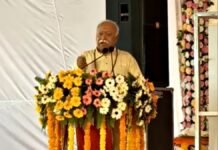
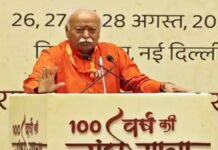
Speaking at the “100 Years of Sangh Journey, New Horizons” lecture series in Mumbai on Saturday, February 7, 2026, RSS Chief Mohan Bhagwat articulated a vision for the organization’s second century. He underscored that the RSS’s work remains unique globally because its core objective is to organize society as a cohesive unit rather than functioning as a reactionary force or a political contender.
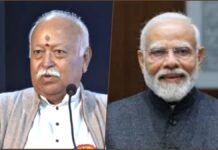
Addressing long-standing public perceptions, Bhagwat directly touched upon the relationship between the Sangh and the ruling government. He clarified that although Prime Minister Narendra Modi is a dedicated Swayamsevak, the Bharatiya Janata Party operates as an independent political organization. He noted that while the Sangh’s volunteers are influential across various sectors, including politics, the RSS itself does not crave popularity, power, or direct administrative control.
Identity and the Definition of “Hindu”
In a significant philosophical clarification, Bhagwat stated that “Hindu” is not a noun but an adjective. He posited that everyone living within the geographical and cultural boundaries of India is a Hindu by virtue of their shared ancestry and civilization. He categorized the current state of Hindu identity into four distinct groups:
- Those who openly and proudly embrace their identity.
- Those who acknowledge their identity but lack a sense of pride.
- Those who maintain their identity in a private or “secret” manner.
- Those who have forgotten their roots due to historical or external pressures.
Bhagwat noted that the term “Hindu” was originally a geographic identifier used by outsiders, but it has evolved into a comprehensive identity for all Indians, including those of Muslim and Christian faiths.
Historical Context and “Religious Neutrality”
Reflecting on the organization’s roots, Bhagwat highlighted the life of RSS founder Dr. Keshav Baliram Hedgewar. He noted that Hedgewar balanced rigorous academic excellence with active participation in India’s freedom struggle, establishing a template for the modern Swayamsevak who contributes to the nation through professional skill and patriotic duty.
The RSS chief also challenged the modern use of the word “secularism.” He argued that the term is often misapplied in India, where “Dharma” (duty/righteousness) is the bedrock of life. He suggested that “Pantnirpekshata,” or religious neutrality, is a more suitable description of the Indian state’s stance, as it acknowledges the foundational role of spirituality while remaining neutral toward specific sects.
A Star-Studded Centennial
The event reflected the Sangh’s growing outreach across various sectors of society. The audience included high-profile figures such as actor Salman Khan, veteran filmmaker Subhash Ghai, lyricist Prasoon Joshi, and actor-MP Hema Malini. Bhagwat concluded by stating that India’s path to becoming a global leader, or “Vishwa Guru,” would not be paved with speeches alone but by the living examples of its citizens acting on a sense of belonging rather than mere transaction.