



























Key Points
- 0.001% of world population (56,000 people) possess more wealth than poorest 4 billion combined
- Richest 1% now control more income and wealth than bottom 90% of global population
- Top 10% own 75% of global wealth while poorest 50% survive on just 2%
- Billionaires’ wealth growing at 8% annually, double the 4% growth rate of the poorest half
- Richest 10% produce 77% of carbon emissions, poorest 50% responsible for only 3%
- Report advocates for global minimum tax on billionaires and enhanced international cooperation against tax evasion
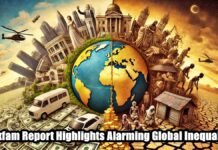
The World Inequality Lab’s latest report, released this week, presents stark evidence that global inequality has reached historically unprecedented levels, threatening democratic institutions and social stability worldwide. The comprehensive study, led by renowned economist Ricardo Gomez Carrera, demonstrates that wealth concentration has accelerated dramatically since the 1990s, creating a two-tiered global economy where a microscopic elite controls resources equivalent to entire continents of people.
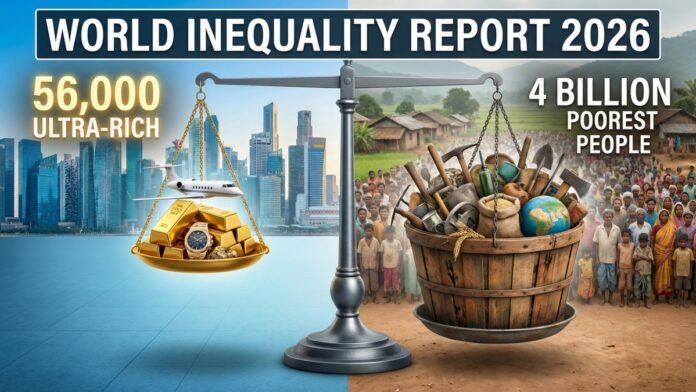
The most shocking finding reveals that a mere 56,000 individuals, representing 0.001% of the world’s population, collectively possess more wealth than the poorest 4 billion people combined. This extreme concentration means that the ultra-wealthy elite, who could fit into a large stadium, control more resources than half of humanity struggling with poverty, limited access to healthcare, education, and basic infrastructure.
The One Percent Versus the Ninety Percent
The report’s data shows that the richest 1% of the global population now commands more income and wealth than the bottom 90% combined, a disparity that has widened significantly over the past three decades. This elite group, approximately 80 million people, owns 43% of global financial assets, including stocks, bonds, and real estate, while the poorest 90% share just 41% of these wealth-generating resources.
Meanwhile, the top 10% of wealth holders control 75% of global wealth, leaving the remaining 90% of humanity to share just one-quarter of the world’s resources. The poorest 50% of the population, comprising 4 billion people, survive on a mere 2% of global wealth, with average assets of less than $10,000 per adult. This stark divide has created parallel worlds where the ultra-wealthy inhabit a realm of private jets, multiple residences, and tax havens, while billions struggle with food insecurity, inadequate housing, and limited economic mobility.
Accelerating Wealth Accumulation Among Billionaires
Since the 1990s, billionaire wealth has grown at an average annual rate of 8%, significantly outpacing global economic growth and wage increases for ordinary workers. In contrast, the wealth of the poorest half of the population has grown at only 4% annually, effectively meaning that inequality is compounding at a rate that makes bridging the gap increasingly difficult. This divergence has accelerated particularly since the 2008 financial crisis and the COVID-19 pandemic, during which billionaire fortunes surged while low-income communities faced job losses and reduced social support.
The report highlights that this wealth accumulation is not merely a result of innovation or entrepreneurship, but is heavily influenced by preferential tax policies, deregulation, and financial systems that favor capital over labor. Tax cuts for high-income earners, loopholes in international tax law, and the proliferation of offshore financial centers have allowed the ultra-wealthy to shield trillions of dollars from taxation, depriving governments of resources needed for public services.
Environmental Impact and Carbon Inequality
A particularly alarming finding reveals that the world’s richest 10% of people are responsible for producing 77% of global carbon emissions, while the poorest 50% contribute only 3% of emissions. This extreme carbon inequality means that climate change, driven primarily by luxury consumption, private aviation, multiple residences, and high-carbon lifestyles of the wealthy, disproportionately affects the poorest populations who lack resources for adaptation and mitigation.
The report connects this environmental disparity to wealth concentration, noting that the carbon footprint of a billionaire can exceed that of thousands of low-income individuals combined. Private jets, superyachts, and mansions generate emissions far beyond global averages, while the poor, who often lack access to reliable electricity or transportation, bear the brunt of climate impacts including extreme weather, crop failures, and displacement.
Threats to Democracy and Global Stability
According to lead author Ricardo Gomez Carrera, inequality remains silent until it becomes shameful, and this report gives voice to billions whose lives are suffocated by unequal social structures. The concentration of wealth translates directly into political influence, as the ultra-wealthy can fund political campaigns, lobby for favorable policies, and shape media narratives, effectively undermining democratic principles of equal representation.
The report warns that extreme inequality poses a serious challenge to democracy and global stability, as it erodes social cohesion, increases crime rates, and fuels political extremism. When large segments of the population feel excluded from economic progress, they become vulnerable to populist movements that promise radical change but often deliver further instability. The study cites examples from multiple countries where inequality has correlated with democratic backsliding and social unrest.
Policy Recommendations for Tax Justice
The World Inequality Report 2026 advocates for fundamental reforms to create a more equitable global economic system. Central to its recommendations is the implementation of a progressive tax system that taxes wealth, inheritance, and high incomes at rates that reflect their social impact. The report specifically calls for a global minimum tax on billionaires, set at 2% of their wealth annually, which could generate hundreds of billions of dollars for public services.
Enhanced international cooperation is essential to prevent tax evasion and close loopholes that allow wealth to be hidden in offshore jurisdictions. The report proposes creating a global financial registry to track ownership of assets and ensure transparency, making it harder for the ultra-wealthy to conceal their fortunes. Additionally, it recommends strengthening international agreements on automatic exchange of tax information and imposing sanctions on tax havens that refuse to cooperate.
Resource Redistribution for Public Services
The report argues that resources recovered through fair taxation should be directed toward universal public services, including healthcare, education, and social protection. Investing in these areas would not only reduce inequality but also boost economic productivity and social mobility. The study estimates that a 2% wealth tax on billionaires alone could fund universal primary healthcare for 500 million people currently lacking access.
Furthermore, the report suggests implementing inheritance taxes to prevent the entrenchment of dynastic wealth, and using the revenue to fund education and job creation programs. It also advocates for strengthening workers’ bargaining power through unionization support and minimum wage policies that keep pace with productivity gains.
Global Implications and Urgent Action Needed
The findings of the World Inequality Report 2026 serve as a wake-up call for policymakers worldwide. The current trajectory suggests that without intervention, inequality will continue to worsen, threatening social fabric and democratic institutions. The report emphasizes that inequality is not inevitable but results from policy choices that can be reversed through political will and international cooperation.
As the world grapples with climate change, pandemic recovery, and technological disruption, addressing extreme wealth concentration becomes not just a matter of social justice but a prerequisite for sustainable development. The report concludes that the silent crisis of inequality has become too shameful to ignore, and the time for comprehensive reform is now.