

































Key Points:
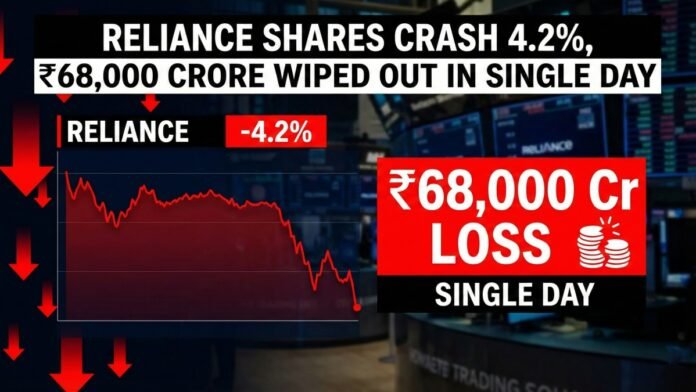
- Reliance Industries shares plummeted 4.20% on Monday, opening at ₹1450.60 and falling to ₹1406.30
- Market capitalization crashed by ₹68,000 crore, from ₹19,72,493.21 crore to ₹19,04,996 crore
- Third-quarter results announced Friday after market close triggered massive selling by investors
- ICICI Bank also tumbled from ₹1413 to ₹1360, with Wipro, Titan, and TCS facing selling pressure
- BSE Sensex dropped 500 points and Nifty fell over 150 points amid broad market selloff
- Brokerage firms maintain ‘Buy’ ratings with targets of ₹1,683 and ₹1,808, citing long-term potential
Monday proved to be a “Black Monday” for Reliance Industries investors as the stock witnessed a sudden and severe slump following the company’s third-quarter results announcement. India’s largest company by market capitalisation, led by the country’s richest man, Mukesh Ambani, saw its shares plummet as soon as trading began, triggering panic among investors.
The stock opened at ₹1450.60 against its previous close of ₹1461, but the decline accelerated rapidly, pushing the price down to ₹1406.30 in early trading. The sharp 4.20 per cent fall left investors with little time to react as billions of rupees evaporated from the market within hours.
Massive Wealth Destruction in a Single Session
The market capitalisation of Reliance Industries suffered a devastating blow, crashing from ₹19,72,493.21 crore on Friday’s close to ₹19,04,996 crore on Monday. This represents a staggering loss of ₹68,000 crore in investor wealth in just one trading session. The scale of the wealth destruction highlights the sensitivity of large-cap stocks to earnings disappointments and market sentiment.
The impact extended beyond Reliance, affecting the entire banking sector and other major stocks. ICICI Bank, another heavyweight, saw its share price tumble from ₹1413 to ₹1360, reducing its market capitalisation to ₹9.80 lakh crore. Shares of other large companies, including Wipro, Titan, and TCS, also came under heavy selling pressure, contributing to the broader market decline.
Third Quarter Results Trigger Sell-Off
Market experts attribute the sharp decline primarily to Reliance’s third-quarter results, which were announced after market hours on Friday. While the company reported profits, market expectations and future projections appear to have fallen short of investor hopes, prompting large-scale selling on Monday.
The reaction underscores the high expectations built into Reliance’s stock price, where even profitable results can lead to selloffs if they don’t meet ambitious market forecasts. Despite delivering approximately 15 per cent returns to investors over the last year, the recent decline has raised concerns among short-term investors who may have entered at higher levels.
Banking Sector Mirrors Reliance’s Plight
The market downturn wasn’t limited to Reliance alone, as the banking sector giant ICICI Bank also faced severe selling pressure. The combined weakness in these heavyweights dragged the broader indices down, with the BSE Sensex trading down by 500 points and the Nifty falling by more than 150 points.
The synchronised decline across multiple large-cap stocks suggests a broader market nervousness, possibly triggered by Reliance’s results but amplified by existing concerns about valuations, global economic conditions, or sector-specific challenges.
Brokerage Houses Maintain Confidence Amid Chaos
Despite the significant fall, several brokerage firms continue to express confidence in Reliance’s long-term prospects. Experts have maintained a ‘Buy’ rating for the stock with a target price of ₹1,683, believing that the company’s new energy projects are progressing on the right track.
Brokerage firm Nuvama has set an even more optimistic target of ₹1,808 and advised investors to buy the stock, citing the upcoming Jio IPO as a potential catalyst that could support the share price in the future. These recommendations suggest that institutional analysts view the Monday decline as a temporary setback rather than a fundamental deterioration in the company’s prospects.
Investment Opportunity or Risk?
Market experts suggest that investors should focus on a long-term perspective instead of making panic-driven decisions. The consensus among analysts appears to be that Reliance’s diversified business model, spanning energy, telecommunications, retail, and new energy initiatives, provides a solid foundation for future growth.
The company’s strategic initiatives, including the preparation for the Jio IPO and expansion in renewable energy, are seen as key value drivers that could support the stock price over the medium to long term. However, the immediate volatility highlights the risks associated with large-cap stocks when they face earnings-related disappointments.
Market Outlook and Investor Strategy
The Monday crash serves as a reminder of the importance of risk management and portfolio diversification, even in supposedly stable large-cap stocks. While long-term investors may view the decline as a buying opportunity, short-term traders need to exercise caution given the current volatility.
The broader market weakness, with the Sensex and Nifty both posting significant losses, indicates that investor sentiment remains fragile. Until there’s clarity on Reliance’s future earnings trajectory and broader market conditions stabilise, volatility is likely to persist in the near term.