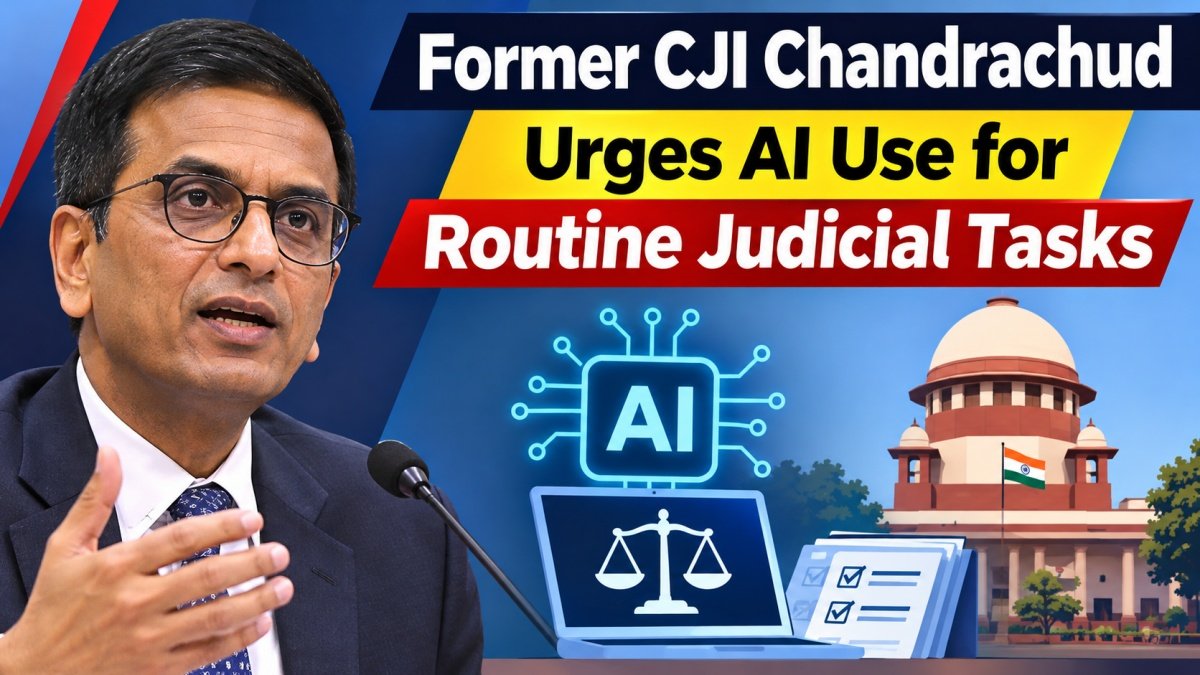
Former Chief Justice of India DY Chandrachud stated that while AI can handle tedious court tasks, the final responsibility for judgments and reasoning must remain exclusively with human judges.
Key Points
- Human Oversight: Judges must personally write and sign all judgments to ensure accountability.
- Routine Automation: AI is suitable for transcription, translation, and identifying document deficiencies.
- Bail Restrictions: The use of AI to assess bail risk or witness credibility is strictly prohibited.
- Draft Rules: Proposed guidelines focus on transparency, data security, and judicial independence.
- Data Sovereignty: The former CJI called for a sovereign database and an AI model made in India.
Human Responsibility in Judicial Decisions
NEW DELHI: Former Chief Justice of India DY Chandrachud has advocated for a balanced approach to integrating Artificial Intelligence (AI) within the Indian legal system. Speaking at the program ‘AI for All: AI Governance and Trust’ on Saturday, Chandrachud asserted that while AI can efficiently manage repetitive and mundane tasks, the core functions of the judiciary, specifically drafting judgments and providing legal reasoning, must remain the sole responsibility of human judges.
The former CJI highlighted that the primary tragedy of the current Indian justice system is that judges are often bogged down by administrative work that should constitute the smallest portion of their duties. He argued that by delegating tasks like transcription, translation, and case listing to AI, judges can focus more effectively on making immediate and critical decisions.
Chandrachud warned against the risks of machine-generated errors, citing instances where AI has created fake legal references. He emphasized that any citation or translation produced by a machine must be verified by a human, and a comprehensive record of every AI tool’s usage must be maintained.
Proposed Rules and Ethical Boundaries
The former CJI briefed the audience on draft rules issued by the Supreme Court’s AI Committee on June 3. These proposed guidelines, intended for use from the Supreme Court down to trial courts and tribunals, are built on the pillars of human priority, transparency, accountability, data security, and judicial independence. The rules permit AI for research and case management but explicitly ban its use in determining an individual’s bail risk or assessing a witness’s credibility.
Chandrachud stressed that in matters involving fundamental rights or personal freedoms, opaque systems must not be permitted. He proposed that litigants should be informed whenever AI is used to translate evidence or summarize appeals, ensuring they have the right to contest any inaccuracies. Furthermore, he suggested that parties using AI in their arguments should be required to disclose this information.
To ensure the integrity of these systems, the former CJI suggested creating a database of incidents to track discrepancies and establishing a mechanism to challenge AI-related errors, such as incorrect translations. He also called for independent audits and specific training for district judges to navigate these new technologies.
Five Tests for Judicial AI
To guide the implementation of technology, Chandrachud outlined five specific tests. First, he insisted that judgments and signatures must be human-led because a language model cannot take an oath or be held accountable in an appeal. Second, he stated that freedom can never be determined by a probability score, as a risk score cannot replace the nuanced assessment of a person standing before a court under Article 21 of the Constitution.
The third test requires transparency, where litigants are notified of AI usage. The fourth test focuses on accessibility, ensuring that technology reaches the person at the back of the queue, such as providing judgments in regional languages like Marathi or Assamese. Finally, he emphasized data security, advocating for a sovereign database and an AI model developed within India.
Despite these safeguards, Chandrachud clarified that these tests are not against technology but are designed to mirror the qualities of a good judge. He noted that technological help is essential given the massive backlog of approximately 5.64 crore pending cases in the country, where the current ratio of judges to the population remains significantly below previous Law Commission recommendations.
Current Technological Initiatives
The former CJI also highlighted several ongoing technological advancements within the Indian judiciary. These include the ‘Suvas’ translation tool, which has translated judgments into 18 Indian languages, and the use of AI transcription for court arguments. Additionally, from November 1, 2025, speech-to-text technology will be used to record witness statements in all trial courts in Kerala.
A new tool being tested in collaboration with IIT Madras aims to identify deficiencies in petitions and documents filed in new courts. While embracing these tools, Chandrachud issued a stern reminder to the legal profession, noting that lawyers cannot hold technology responsible for mistakes made in their arguments and must read judgments in full before citing them.