

































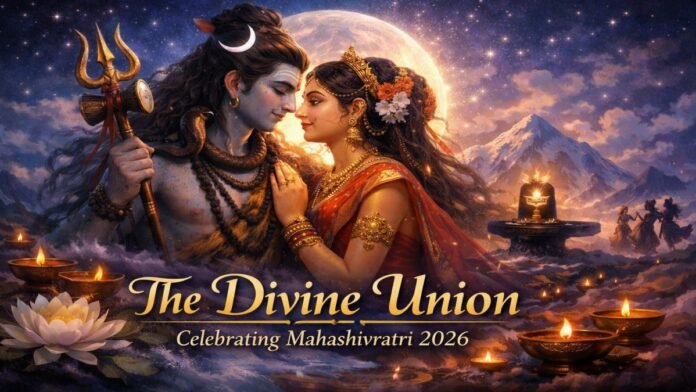
Tomorrow, February 15, 2026, the cosmos aligns for Mahashivratri, the “Great Night of Shiva.” While many festivals celebrate victories or birthdays, Mahashivratri honors the ultimate union of the masculine and feminine energies: the marriage of Lord Shiva and Mother Parvati.
For those observing the fast or keeping the midnight vigil, reciting the story of their union is more than a ritual; it is said to invite the same harmony, stability, and “eternal suhaag” (marital bliss) into one’s own life.
The Cosmic Prelude: From Sati to Silence
The journey to this divine marriage began in heartbreak. In her previous incarnation, the Goddess was Sati, daughter of King Daksha. Despite her father’s disdain for the “ascetic” Shiva, she chose him as her lord. However, when Daksha insulted Shiva during a grand sacrifice (Yajna), Sati could not bear the humiliation of her husband and sacrificed herself in the yogic fire.
Consumed by grief and fury, Shiva unleashed Veerabhadra to destroy the sacrifice. He then retreated into the icy depths of the Himalayas, entering a state of profound, world-shaking meditation. He became Vairagi—the detached one—and the world grew cold without the warmth of Shakti.
The Rebirth: Parvati’s Unshakable Resolve
Sati returned to the world as Parvati, the daughter of King Himavan and Queen Maina. Though born into royalty, her heart remained anchored to the snowy peaks where Shiva meditated.
Guided by the wisdom of Narada Muni, Parvati undertook penance (Tapasya) so severe it shifted the energy of the universe:
- The Early Years: She traded palace comforts for the forest, surviving only on fruits.
- The “Aparna” Phase: She eventually gave up all food, consuming only fallen leaves. When she stopped eating even those, she earned the name Aparna.
- The Ultimate Sacrifice: Finally, she lived on breath alone, her internal fire glowing so brightly it caught the attention of the gods.
The Test of Love and the Third Eye
The gods, desperate for Shiva to return to the world to maintain balance, sent Kamadeva (the God of Love) to stir Shiva’s heart. Kamadeva fired an arrow of flowers at the Great Ascetic. Enraged by the interruption, Shiva opened his third eye, reducing Kamadeva to ashes instantly.
Yet, Parvati did not flinch. Seeing her devotion, Shiva decided to test her himself. Disguised as a young Brahmin (a Batu), he approached her and mocked Shiva:
“Why wed a man who wears snakes, haunts cremation grounds, and covers himself in funeral ash? He has no wealth, no lineage, and no manners!”
Parvati’s eyes flashed with conviction. She replied that the “Lord of the Three Worlds” cannot be measured by human standards of beauty or wealth. Touched by her unwavering soul, Shiva shed his disguise, appearing in his true, radiant form to accept her as his bride.
The Most Extraordinary Wedding Guest List
The wedding was a spectacle unlike any other in history. Shiva arrived riding Nandi, his bull. His procession (Baraat) was a wild mix of:
- The Divine: Brahma, Vishnu, and the celestial Gandharvas.
- The Earthly: Sages and kings.
- The Outcasts: Ghosts, spirits, and Ganas who danced to the rhythm of his Damru.
Initially, Queen Maina was terrified by Shiva’s fierce, ash-smeared appearance. To calm her, Shiva transformed into Chandrashekhar, the most handsome being in existence, adorned with the crescent moon.
In a ceremony witnessed by the holy fire, with Lord Vishnu performing the Kanya Daan and Lord Brahma chanting the sacred mantras, the two became one.
Why We Celebrate at Midnight
Spiritual tradition holds that the actual wedding took place at the stroke of midnight. This is why the Nishita Kaal Puja is considered the most powerful time to pray.
The Blessings of the Night:
- For the Unmarried: It is believed to remove obstacles in finding a soulmate.
- For the Married: It fosters deep understanding and longevity of the bond.
- For the Seeker: It represents the union of the soul (Jiva) with the Supreme Consciousness (Shiva).
As you light your lamps and offer Bilva leaves tomorrow, remember: Mahashivratri is a reminder that with enough devotion, even the most distant Divine can be reached.