































Key Highlights
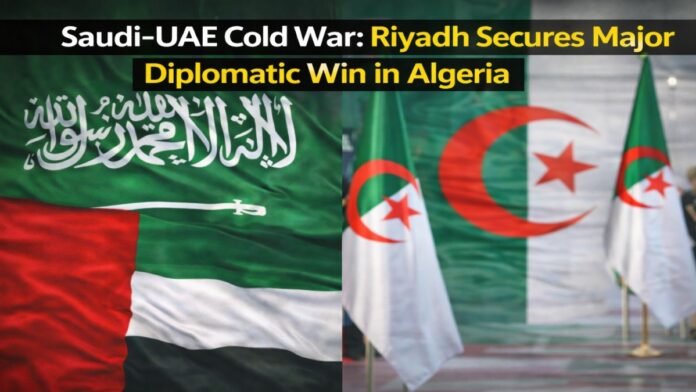
- Strategic Pivot: Saudi Arabia has successfully pulled Algeria into its diplomatic orbit, moving it away from the UAE’s sphere of influence.
- $7 Billion Agreement: Riyadh and Algiers have signed a massive $7 billion (₹58,000 crore) deal focused on wastewater management and infrastructure.
- Aviation Breakdown: Algeria has initiated the legal termination of its 2013 air services agreement with the UAE, threatening to end direct flight links.
- Security Framework: A landmark security pact is in its final stages, potentially positioning Saudi Arabia as a primary guarantor of Algerian security.
- Sovereignty Dispute: Relations soured after President Abdelmadjid Tebboune accused the UAE of meddling in the 2024 presidential elections and supporting separatist groups.
The rivalry between Saudi Arabia and the United Arab Emirates (UAE), the two dominant powers of the Arab world, has reached a new boiling point in the Mediterranean. In a move that analysts are calling a major strategic defeat for Abu Dhabi, Algeria has begun dismantling its long-standing ties with the UAE in favor of a deep-seated partnership with Riyadh.
On Monday, Feb 9, 2026, details emerged of a massive $7 billion investment by Saudi Arabia into Algeria’s wastewater management systems. This economic offensive is paired with a burgeoning security alliance. Negotiators are currently finalizing a deal that would see Saudi Arabia providing extensive security support and intelligence sharing with Algeria, a move that has already begun to shift the United States’ diplomatic calculus in the region.
Allegations of Interference and the Aviation Rift
The catalyst for Algeria’s “rebellion” against the UAE stems from acute concerns over national sovereignty. President Abdelmadjid Tebboune has publicly hinted at “hostile actions” by a “brotherly Arab country,” a reference widely understood by diplomats to be the UAE. Specifically, Algiers has accused Abu Dhabi of attempting to influence the 2024 presidential elections and providing logistical support to the Movement for the Autonomy of Kabylia (MAK), which Algeria classifies as a terrorist organization.
In response, Algeria has invoked Article 22 of its 2013 air services agreement to initiate a total termination of the pact. This legal process, which involves formal notification to the International Civil Aviation Organization (ICAO), could see direct flights between Algiers and Dubai cease entirely by February 2027, severely impacting tourism, cargo flows, and business travel.
Broader Regional Rivalry: Sudan, Yemen, and Beyond
The struggle for influence in Algeria is the latest chapter in a broader Saudi-Emirati divergence that has destabilized several conflict zones. In Sudan, Saudi Arabia supports the central government and the SAF, while the UAE is accused of backing the Rapid Support Forces (RSF). In Yemen, the two have supported opposing factions, with Saudi forces recently taking kinetic action against UAE-backed shipping interests to curb separatist momentum.
Algeria’s strategic location makes it a high-stakes prize. As Africa’s largest country by landmass, it sits on the Mediterranean coast where approximately 20 percent of global shipping traffic passes. By securing Algiers, Saudi Arabia is building a “Middle Corridor” of influence that emphasizes state legitimacy and border integrity, contrasting with the UAE’s strategy of engaging with non-state actors and separatist movements.
US Perspective and Future Outlook
The Biden-Trump transition era in Washington has seen a renewed focus on regional stability. The US has reportedly viewed the Saudi-Algerian rapprochement as a stabilizing factor that could prevent further fragmentation in the Maghreb. Experts believe that if the Saudi-Algerian security pact is signed, it will represent an unprecedented geopolitical shift, effectively locking the UAE out of North African security architecture for the foreseeable future.