































Key Highlights
- Historic Motion: 118 MPs from the Congress, Samajwadi Party, and DMK signed the notice seeking the Speaker’s removal under Article 94(c) of the Constitution.
- TMC Stance: The Trinamool Congress has opted not to sign the motion immediately, instead giving the Speaker a two,to,three day window to address their grievances.
- The Catalyst: The standoff began on February 2 when Leader of the Opposition Rahul Gandhi was prevented from quoting former Army Chief General M.M. Naravane’s unpublished memoir.
- Mass Suspension: Eight opposition MPs were suspended for the remainder of the Budget Session on February 3 following protests in the Well of the House.
- Procedural Next Steps: The Lok Sabha Secretariat must now examine the notice and schedule a discussion within 14 days, requiring the support of at least 50 members to proceed.
Parliamentary Deadlock: The Push for Removal
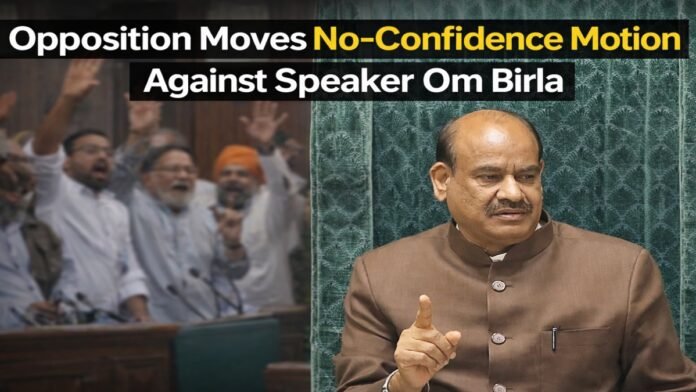
The political climate in New Delhi reached a boiling point on Tuesday, February 10, 2026, as the opposition formally moved to oust Lok Sabha Speaker Om Birla. Led by Congress Deputy Leader Gaurav Gogoi, Chief Whip Kodikunnil Suresh, and MP Mohammad Javed, the notice was submitted to the Lok Sabha Secretariat at 1:14 PM. The move follows a week of unprecedented disruptions and allegations that the Chair has compromised its role as a neutral arbiter.
The notice, invoking Article 94(c) of the Constitution and Rule 94C of the House procedures, bears the signatures of 118 lawmakers. While the INDIA bloc appears largely united, the Trinamool Congress (TMC) has maintained a strategic distance. TMC leader Abhishek Banerjee stated that while the party supports the grievances, they preferred an initial formal appeal to the Speaker, granting him a 72,hour ultimatum to rectify his conduct before resorting to a no,confidence vote.
Roots of the Conflict: The Naravane Memoir Row
The immediate trigger for this constitutional challenge was an exchange on February 2 during the Motion of Thanks to the President’s Address. Rahul Gandhi attempted to reference “Four Stars of Destiny,” the unpublished memoir of former Army Chief General M.M. Naravane, to raise concerns about national security and the 2020 border standoff with China.
The Treasury benches, led by Defence Minister Rajnath Singh and Parliamentary Affairs Minister Kiren Rijiju, vehemently objected, arguing that unpublished literature cannot be cited in the House. Speaker Om Birla upheld this objection, ultimately expunging Gandhi’s remarks from the record and preventing him from completing his speech. The opposition viewed this as a direct assault on the democratic rights of the Leader of the Opposition, alleging that the Chair was shielding the government from difficult questions.
Escalation and Suspensions
The confrontation intensified on February 3 when the House witnessed chaotic scenes. Following the Speaker’s refusal to allow further discussion on the China issue, opposition members entered the Well of the House, leading to the suspension of eight MPs: Hibi Eden, Amarinder Singh Raja Warring, Manickam Tagore, Gurjeet Singh Aujla, Kiran Kumar Reddy, Prashant Padole, Dean Kuriakose (all Congress), and S. Venkatesan (CPI,M).
The opposition’s notice specifically cites these “arbitrary” suspensions and the Speaker’s failure to reprimand ruling party members for personalized attacks on former Prime Ministers as evidence of a “blatantly partisan” approach.
Constitutional Procedure and Historical Context
Removing a Speaker is a rare and difficult process in Indian parliamentary history. Under Article 94(c), a Speaker can be removed by a resolution passed by a majority of all the then members of the Lok Sabha. The notice must be given at least 14 days in advance, and the Speaker cannot preside over the House while the resolution for his removal is under consideration.
Historically, only three such motions have been introduced:
- 1954: Against G.V. Mavalankar (Rejected)
- 1966: Against Hukam Singh (Failed due to lack of support from 50 members)
- 1987: Against Balram Jakhar (Rejected after debate)
With the Secretariat now tasked with examining the current notice, the Budget Session of 2026 is set to remain a high,stakes battleground over the very rules that govern the temple of democracy.
Would you like me to prepare a detailed breakdown of the voting requirements and the current seat strength of the parties involved in this motion?