



































Key Highlights
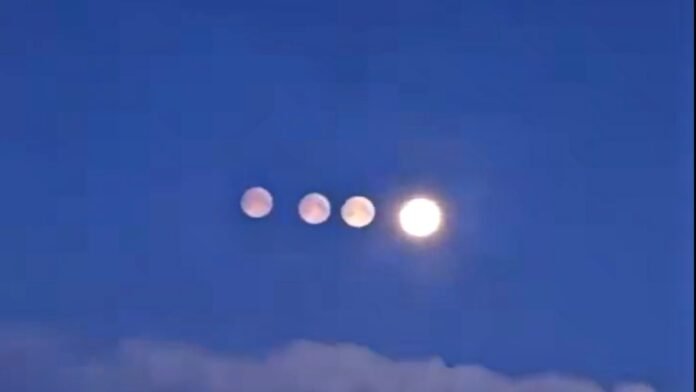
- The Event: Residents observed four luminous, moon-like objects in the night sky.
- The Cause: A rare optical phenomenon known as “paraselene” caused by moonlight refracting through hexagonal ice crystals.
- Weather Conditions: Atmospheric temperatures plunged below -20°C, providing the perfect conditions for high-altitude crystal formation.
- Scientific Verdict: Experts confirm the event is a natural occurrence, not supernatural, similar to the more common “sun dog.”
On the night of Sunday, February 1, 2026, the historic skyline of St. Petersburg became the backdrop for one of nature’s most elusive optical displays. Four distinct, glowing orbs appeared to hang in the sky simultaneously, stopping traffic and flooding social media with viral footage of the “multiple moons,” a sight that many locals initially described as surreal or otherworldly.
Astronomers were quick to provide a scientific explanation for the display, identifying it as a complex version of paraselene, commonly referred to as “moon dogs.” While the appearance of two false moons is documented in arctic regions, the presence of four distinct points of light is considered highly unusual, requiring a specific alignment of moonlight, cloud height, and crystal geometry.
The Role of Extreme Cold and Ice Crystals
The primary driver for this event was the intense cold wave currently gripping the region. With temperatures plummeting past -20 degrees Celsius, the moisture in the upper atmosphere crystallized into millions of microscopic, hexagonal ice prisms.
These crystals, typically found within thin cirrus clouds, act as natural lenses. As moonlight passes through the flat faces of these crystals, it is refracted at a precise 22-degree angle. This bending of light creates a “22-degree halo” around the moon, and when the crystals are oriented horizontally as they sink through the air, they concentrate the light into bright spots on the left and right, known as parhelia when involving the sun, and paraselene when involving the moon.
Comparing Moon Dogs and Sun Dogs
While “sun dogs” are relatively common in cold climates during the day, moon dogs are significantly rarer because they require a nearly full, exceptionally bright moon to be visible to the naked eye. On this specific night, the moon’s high luminosity combined with the high-density ice cloud coverage allowed for multiple refraction points, resulting in the illusion of four moons rather than the standard two.
Scientists noted that the St. Petersburg event provided a rare opportunity to study atmospheric light scattering in real-time. The event serves as a vivid reminder of how the Earth’s atmosphere can manipulate light to create spectacular, if temporary, masterpieces that challenge our visual perception of the cosmos.