

































Key Points:
- ISRO’s LVM3-M6 rocket launched BlueBird Block-2 satellite at 8:54 AM from Sriharikota
- 6,100 kg satellite is heaviest commercial payload ever delivered to LEO by an Indian rocket
- Satellite will provide direct cellular broadband to ordinary smartphones globally
- Launch conducted under commercial agreement between NSIL and AST SpaceMobile
- Part of global LEO constellation enabling 4G/5G voice, video, and data services worldwide
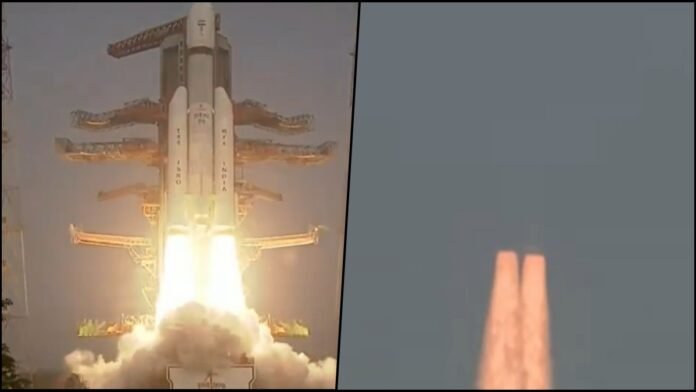
The Indian Space Research Organisation achieved a significant commercial and technical milestone on Wednesday morning by successfully launching the BlueBird Block-2 satellite for AST SpaceMobile using its most powerful rocket, the Launch Vehicle Mark-3 (LVM3-M6). The launch took place at precisely 8:54 AM from the Satish Dhawan Space Centre in Sriharikota, marking another successful mission for India’s heavy-lift capability. This mission represents not just a routine satellite deployment but a breakthrough in direct-to-cellular technology that could revolutionise global connectivity.
The 6,100 kilogram BlueBird Block-2 satellite establishes a new record as the heaviest payload ever carried to Low Earth Orbit by ISRO’s LVM3 rocket, surpassing the previous record held by the CMS-03 satellite launched on November 2nd of this year, which weighed approximately 4,400 kilograms. This achievement demonstrates the growing payload capacity and reliability of India’s launch vehicles in the competitive global commercial space market. The mission was executed under a commercial agreement between NewSpace India Limited (NSIL), ISRO’s commercial arm, and Texas-based AST SpaceMobile, highlighting India’s emerging role as a preferred launch service provider for next-generation satellites.
Revolutionary Direct-to-Phone Technology
BlueBird Block-2 represents a paradigm shift in satellite communication architecture. Unlike traditional satellites that require specialized ground equipment, this low-earth orbit communication satellite is designed to provide direct cellular broadband connectivity to ordinary smartphones worldwide without any additional antennas or special devices. The technology enables seamless integration with existing cellular networks, allowing users to make 4G and 5G voice and video calls, send text messages, stream content, and access high-speed data services directly from space.
The satellite’s massive deployable array, spanning approximately 400 square meters, acts as a cellular tower in space, communicating directly with standard mobile handsets. This capability addresses the connectivity gap for the 5 billion mobile users globally, particularly benefiting remote areas, maritime regions, and locations where terrestrial infrastructure is unavailable or unreliable. The BlueBird Block-2 mission serves as a pathfinder for AST SpaceMobile’s ambitious plan to deploy a global LEO constellation that will provide ubiquitous coverage.
Strategic Commercial Implications
This launch underscores ISRO’s growing competitiveness in the international commercial launch market. NSIL has been aggressively pursuing partnerships with global satellite operators, and this mission with AST SpaceMobile, valued at approximately ₹450 crore, represents one of the most significant commercial contracts for India’s space agency. The successful deployment strengthens ISRO’s position as a cost-effective and reliable launch service provider capable of handling sophisticated, heavy payloads.
The LVM3 rocket, also known as GSLV Mk III, demonstrated its enhanced capabilities by precisely injecting the satellite into its intended 750 km circular orbit at an inclination of 43 degrees. The rocket’s cryogenic upper stage performed flawlessly, completing the mission in just under 18 minutes. This precision is crucial for satellites like BlueBird Block-2, which require specific orbital parameters for optimal coverage and handoff between space-based and terrestrial networks.
Future Constellation and Global Impact
BlueBird Block-2 is the second prototype in AST SpaceMobile’s planned constellation of over 100 satellites. The company aims to achieve initial service capability with a handful of satellites, eventually scaling to provide continuous global coverage. Each satellite in the constellation will communicate with the others using inter-satellite links, creating a mesh network that ensures seamless connectivity as users move between coverage areas.
The technology has attracted significant investment and partnerships from major mobile network operators worldwide, including Vodafone, AT&T, and Rakuten. These partnerships are essential for regulatory approvals and spectrum coordination, as the satellite system must integrate with existing cellular frequencies without causing interference. The successful launch and deployment of BlueBird Block-2 will enable AST SpaceMobile to conduct extensive testing with partner networks across multiple continents.
Technical Challenges and Innovations
Developing a satellite capable of communicating directly with smartphones presented numerous engineering challenges. The satellite must generate sufficient power to transmit signals strong enough to be received by devices with small, low-gain antennas while complying with strict power flux density limits set by international regulators. BlueBird Block-2 addresses this through its large solar arrays and advanced digital beamforming technology, which focuses signal strength precisely where needed.
The satellite also incorporates sophisticated software-defined radio technology, allowing it to adapt to different cellular standards and frequencies used by partner networks worldwide. This flexibility is crucial for a global service that must operate across diverse regulatory environments and technical standards. ISRO’s ability to successfully launch such a complex payload demonstrates the maturity of India’s space infrastructure and its capacity to support cutting-edge commercial missions.
India’s Space Commerce Trajectory
With this launch, ISRO has now conducted six successful LVM3 missions, establishing a track record that appeals to commercial customers. NSIL has a full manifest of upcoming launches for both Indian and international customers, including more satellites for AST SpaceMobile’s constellation. The Indian government has been supportive of expanding commercial space activities, recently announcing policy reforms to encourage private sector participation and foreign investment in the space sector.
The success of BlueBird Block-2 also validates ISRO’s strategy of developing heavy-lift capability. As satellite sizes increase with more advanced capabilities, launch vehicles like LVM3 become essential for accessing the commercial market. ISRO is already working on the Next Generation Launch Vehicle (NGLV) with even greater payload capacity, positioning India to capture a larger share of the global space economy, projected to reach $1 trillion by 2040.