






















Key Points
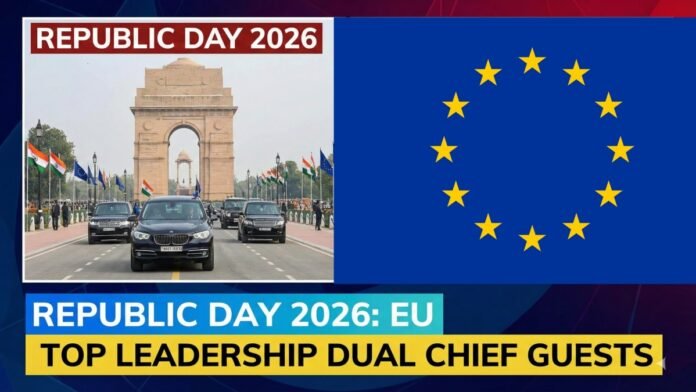
- Ursula von der Leyen and António Costa invited as chief guests for Republic Day 2026, a first for dual EU leadership attendance.
- Visit expected to coincide with India-EU summit and critical FTA negotiations.
- FTA discussions cover trade, investment, technology transfer, digital economy, green energy, and manufacturing.
- EU views India as reliable economic and strategic partner amid global geopolitical shifts.
- Part of India’s balanced multilateral foreign policy, following Indonesian President Prabowo Subianto’s 2025 chief guest appearance.
- Negotiations have been ongoing for several years, with renewed urgency due to supply chain diversification needs.
- European Union seeks to strengthen long-term economic partnership beyond diplomatic relations.
The simultaneous invitation to both von der Leyen and Costa represents a diplomatic masterstroke, elevating the Republic Day ceremony from a bilateral showcase to a multilateral strategic platform. European Commission President von der Leyen, who has served since 2019 and recently secured her second term, oversees the EU’s executive arm and trade negotiations. European Council President Costa, former Prime Minister of Portugal, coordinates member state positions and strategic direction.
Diplomatic sources reveal that the invitation was extended during Prime Minister Narendra Modi’s bilateral meeting with von der Leyen on the sidelines of the G20 Summit in Rio de Janeiro last month. The EU leadership accepted within 48 hours, indicating Brussels’ eagerness to accelerate partnership talks. This marks only the second time in Republic Day history that two leaders from the same political entity have been invited together, the first being French President Jacques Chirac and Prime Minister Lionel Jospin in 1998.
FTA Negotiations and Strategic Imperatives
The India-EU Free Trade Agreement negotiations, which resumed in 2022 after a nine-year hiatus, have gained fresh momentum amid shifting global dynamics. The comprehensive agreement aims to eliminate tariffs on 90% of goods, establish mutual recognition of standards, and create robust investment protection mechanisms. Key sticking points include India’s demands for greater access to EU services markets, visa facilitation for professionals, and recognition of geographical indications for Indian products.
EU negotiators are pushing for stringent intellectual property protections, data localisation norms, and sustainable development clauses aligned with European Green Deal standards. The agreement’s scope extends beyond traditional trade to encompass critical areas like semiconductor supply chains, critical minerals partnership, joint defence production, and digital payment systems interoperability. With bilateral trade currently valued at $120 billion, both sides aim to double this figure within five years of agreement implementation.
Geopolitical Context and Supply Chain Diversification
The timing of this diplomatic engagement reflects strategic calculations on both sides. The EU’s “de-risking” strategy from China has made India an indispensable partner for diversifying supply chains in pharmaceuticals, electronics, and renewable energy components. Russia’s war in Ukraine has exposed European vulnerabilities in energy and raw materials, prompting Brussels to seek reliable partners in the Indo-Pacific region.
India, meanwhile, balances its relationships with Russia and the West while positioning itself as the voice of the Global South. The EU partnership offers access to advanced technology, climate finance, and alternative markets as India navigates tensions with China and seeks to reduce strategic dependencies. The Republic Day platform provides Modi government an opportunity to showcase India’s democratic credentials and economic potential to European investors.
Preparations and Expected Outcomes
The Ministry of External Affairs has constituted a special task force to coordinate the visit, given its complexity and scale. The EU delegation is expected to comprise 150-200 officials, business leaders, and parliamentarians, requiring unprecedented security and protocol arrangements. The India-EU summit, likely scheduled for January 25, will produce a joint statement on strategic partnership, digital connectivity, and green transition.
Trade negotiators from both sides will hold intensive parallel sessions, with expectations of announcing a “substantial conclusion” on at least three critical chapters: goods, services, and investment. The leaders may also launch an India-EU Trade and Technology Council, modelled on similar US-EU institutions, to coordinate on emerging technologies and standards. Defence cooperation, including joint production of military equipment and co-development of next-generation technologies, will feature prominently in discussions.
Historical Context and Diplomatic Tradition
The Republic Day chief guest invitation represents India’s highest diplomatic honour, reserved for strategic partners. Since 1950, the tradition has hosted leaders from 105 countries, with selections reflecting India’s foreign policy priorities. The 2025 invitation to Indonesian President Prabowo Subianto emphasised the Act East policy and maritime cooperation in the Indo-Pacific.
The 2026 EU invitation signals India’s pivot toward major economic powers as it seeks to become a $5 trillion economy. It also acknowledges Europe’s role as India’s largest trading partner and a key source of foreign investment, technology, and educational exchanges. The dual leadership format allows both EU institutions to signal equal commitment to the partnership, overcoming internal bureaucratic complexities that have sometimes slowed EU-India engagement.