

































Key points
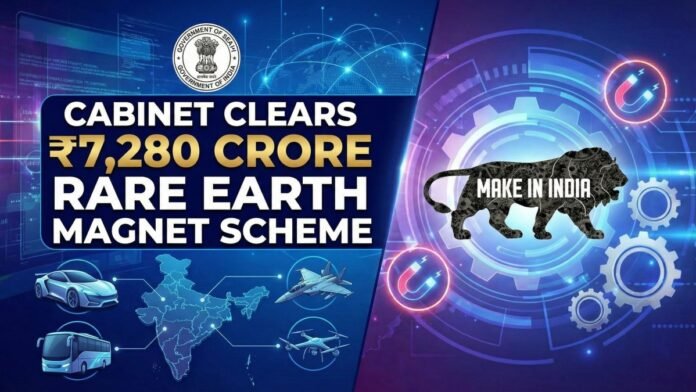
- The Cabinet has approved a “Scheme to Promote Manufacturing of Rare Earth Permanent Magnets” with an outlay of about ₹7,280 crore, targeting 6,000 metric tonnes per year of domestic capacity by 2030.
- India currently imports almost all such magnets, which are critical for electric vehicles, wind turbines, electronics and defence platforms, the scheme is designed to cut this dependence and support the net zero 2070 target.
- Two railway projects worth a total of ₹2,781 crore have been cleared, doubling of the Devbhumi Dwarka, Okha, to Kanalus line in Gujarat and a third and fourth line between Badlapur and Karjat in Maharashtra.
- The Badlapur–Karjat stretch is part of the Mumbai suburban corridor, extra lines are expected to reduce delays, decongest local trains and improve connectivity towards southern India.
- Phase 2 of Pune Metro Rail, covering Line 4 from Kharadi to Khadakwasla and Line 4A from Nal Stop to Warje–Manik Baug, has been approved at an estimated cost of about ₹9,858 crore, with a completion period of five years.
- The new Pune corridors will connect major IT parks, educational hubs and dense residential areas, integrating with existing metro lines and future extensions to create a seamless public transport grid.
NEW DELHI: The “Rare Earth Permanent Magnet” scheme, cleared by the Cabinet, will provide a mix of sales-linked incentives and capital subsidy to build integrated facilities that can process rare earth oxides into metal, alloys and finally high-performance magnets. Around ₹6,450 crore will go as production-based support and about ₹750 crore as capital subsidy, to nurture multiple domestic manufacturers rather than just one or two large players.
Officials say India’s current annual demand of about 4,000 tonnes of such magnets could nearly double by 2030, driven by EV motors, renewable energy, smartphones, aerospace and defence, making local capacity vital for both economic growth and national security. By backing a full value chain inside the country, the scheme is also seen as a response to China’s dominance and export controls in the rare earth space, and as a building block for Aatmanirbhar Bharat in advanced manufacturing.
Rail and metro projects to ease travel
On the rail front, the Cabinet Committee on Economic Affairs has approved doubling of the Devbhumi Dwarka, Okha, to Kanalus line in Gujarat at a cost of about ₹1,457 crore, along with a third and fourth line between Badlapur and Karjat near Mumbai at an estimated ₹1,324 crore. The Gujarat project is expected to improve capacity on a key coastal route that carries both pilgrims and freight, while the extra lines on the Mumbai suburban section will help separate fast and slow trains, cut congestion and support future passenger growth.
For Pune, Phase 2 of the metro network is the big announcement, with the Kharadi–Hadapsar–Swargate–Khadakwasla corridor and the Nal Stop–Warje–Manik Baug spur forming Line 4 and 4A of the system. The 31.6 km expansion, costing about ₹9,858 crore and jointly funded by the Centre, Maharashtra government and external agencies, will be built in five years, and is expected to decongest major arterial roads while linking IT hubs, commercial zones, colleges and thickly populated neighbourhoods to existing Lines 1 and 2.