



































Key points
- Ethiopia’s Hayli Gubbi volcano erupted on 23 November, reportedly for the first time in nearly 12,000 years, sending a massive ash plume up to around 14 km into the sky.
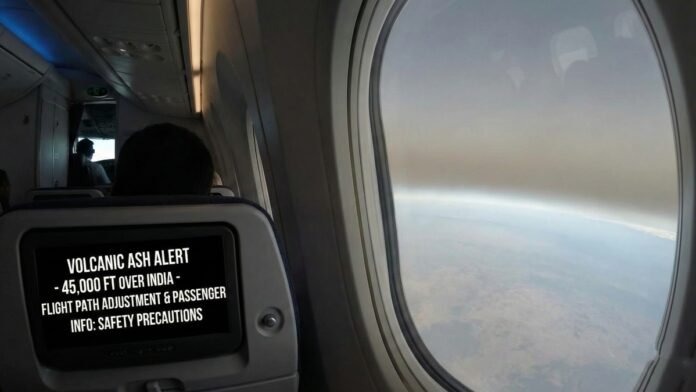
- The ash cloud, travelling roughly 100 to 120 km per hour at altitudes between about 25,000 and 45,000 feet, has drifted across Oman and the Arabian Sea into Indian airspace.
- Ash first entered India over Jodhpur and Jaisalmer, then spread towards Gujarat, Rajasthan, Maharashtra, Delhi, Haryana and is expected to brush Punjab and nearby hill states.
- DGCA and Met offices in Delhi and Mumbai have issued SIGMET and urgent volcanic ash advisories, asking airlines to avoid affected flight levels and rework routes and fuel plans.
- Akasa Air has cancelled its Jeddah, Kuwait and Abu Dhabi flights for 24 and 25 November, IndiGo has cancelled or rescheduled several services, and KLM has suspended its Amsterdam–Delhi–Amsterdam rotation over the ash corridor.
- Experts say the plume is too high to substantially worsen surface air quality in Delhi and north India, but skies can look darker and hazier while flights at cruising levels remain most at risk.
Hayli Gubbi, located in Ethiopia’s Afar region, erupted on 23 November, throwing volcanic ash, sulphur dioxide and fine particles of glass and rock high into the upper troposphere and lower stratosphere. Strong westerly and northwesterly winds then picked up the plume, which satellite data shows moving at around 100 to 120 km per hour across the Red Sea towards the Gulf region and the Arabian Sea.
As the winds steered the cloud east and northeast, ash bands entered the Muscat Flight Information Region and neighbouring corridors that feed Indian routes, before skimming over Oman and advancing towards India at heights of roughly 25,000 to 45,000 feet. By late 24 November, meteorological agencies reported the plume brushing air routes over Gujarat, north west Maharashtra, Rajasthan and central India, with subsequent frames showing it extending across Rajasthan, Haryana, Delhi and moving further towards Punjab and the western Himalayas.
Entry over Rajasthan and spread across north India
According to private weather trackers such as IndiaMetSky Weather, the first significant intrusion into Indian airspace was detected over Jodhpur and Jaisalmer sectors, where the ash cloud crossed the international boundary at cruising altitudes. From there, upper-level winds steered it northeast, stretching the plume over large parts of Rajasthan and then into Haryana, Delhi NCR and adjoining regions through late Monday and Tuesday.
Forecasts now suggest that filaments of the cloud are likely to pass over Punjab, parts of Uttar Pradesh and some hill states, although the density will vary and gradually thin out as the plume disperses. Scientists and the IMD have underlined that since the ash is concentrated several kilometres above the ground, it is more of an aviation hazard than a direct air quality catastrophe, even though it can make daylight appear dimmer and the sky more milky or hazy than usual.
DGCA SIGMET, ASHTAM and safety instructions for airlines
With volcanic ash activity reported in the Muscat FIR and adjoining regions, the Directorate General of Civil Aviation has issued an urgent operational advisory, along with SIGMET and ASHTAM-based warnings coordinated with the Airport Authority of India and the Volcanic Ash Advisory Centre in Toulouse. The regulator has directed airlines and flight dispatch teams to strictly avoid published ash-affected areas and flight levels, update flight plans using the latest satellite imagery and volcanic ash bulletins, and factor in possible diversions and holding patterns while calculating fuel.
Crew and operators have been told to immediately report any suspected encounter with ash, including engine surges, unusual vibrations, smell of smoke in the cabin or visibility degradation, and to carry out post-flight inspections of engines and airframes for aircraft that may have flown near the plume. Airport operators have also been asked to monitor for possible ash deposition, and if contamination is detected, to inspect and clean runways, taxiways and aprons before normal operations resume, with restrictions or temporary suspensions if required.
Flights cancelled, diversions and airline advisories
In response to the safety alerts, Akasa Air has cancelled flights to and from Jeddah, Kuwait and Abu Dhabi for 24 and 25 November, citing significant ash concentrations along these Gulf routes and the need to prioritise passenger safety. IndiGo has withdrawn or rescheduled several services, including at least six flights on sectors likely to intersect the drifting plume, and has told passengers via a public advisory that crews and operations teams are dynamically adjusting routes and timings while closely tracking meteorological updates.
KLM Royal Dutch Airlines has cancelled its Amsterdam to Delhi flight (KL 871) and the return Delhi to Amsterdam service (KL 872), explaining that its standard risk assessment does not allow operations through the affected airspace slices. Other carriers, including Air India, have diverted or slightly rerouted some flights that would normally cross the most ash-impacted corridors, while reassuring passengers that current disruptions are largely confined to higher altitudes and that there is no major effect on most domestic services or on ground-level conditions in Delhi and other Indian cities.